
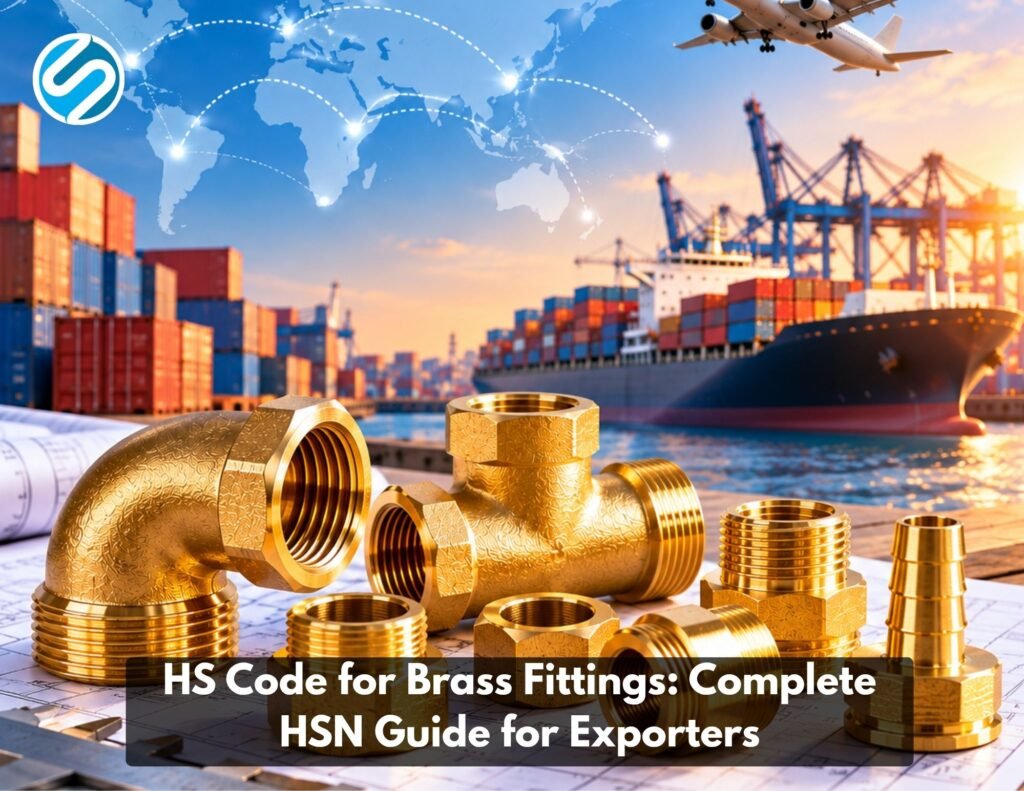
Shipping brass fittings out of India starts with one number on the invoice. The HS code for brass fittings is 7412.20, the international heading for tube and pipe fittings made of copper alloys, and brass is a copper-zinc alloy. Get it right and your cargo clears customs without fuss. Get it wrong and you risk delays, the wrong duty rate or lost export incentives.
This guide explains the correct code, the HSN code full form, how India’s classification system works, codes for related brass parts, GST treatment and the mistakes exporters make most often.
What Is the HS Code for Brass Fittings?
The HS code for brass fittings sits in Chapter 74 of the Harmonized System, which covers copper and articles of copper. Heading 7412 covers copper tube and pipe fittings, and subheading 7412.20 narrows it to fittings made of copper alloys such as brass and bronze. Most Brass Products Exporters in India use 7412.20 for elbows, tees, nipples, couplers, unions, reducers and adaptors.
The first six digits are the same in every country that follows the Harmonized System. Each country then adds its own digits. India uses 8-digit ITC-HS codes, the US uses 10-digit HTS codes and the EU uses 8-digit CN codes. So a brass elbow shipped from Jamnagar to Houston carries 7412.20 on both sides, with local extensions added by each customs authority.
Brass HS Code vs HSN Code: What’s the Difference?
A brass HS code and an HSN code point to the same product, but they serve different systems. HS is the global framework managed by the World Customs Organization (WCO) and used by more than 200 countries. HSN is India’s version of it, extended to eight digits for customs and also used for GST invoicing.
The HSN code full form is Harmonized System of Nomenclature. Indian businesses quote it on tax invoices, shipping bills and e-way bills. Businesses with turnover above ₹5 crore must mention six digits on B2B invoices, while export shipping bills need the full eight-digit ITC-HS tariff line.
Why the Correct Code Matters for Brass Exporters
Classification affects every document that travels with your shipment. Within the Brass Export Supply Chain, the same code appears on the commercial invoice, packing list, shipping bill, certificate of origin and the buyer’s import entry. One mismatch between these documents is enough for customs to hold a container.
- Duty rates: The importing country calculates duty based on the declared code, so a wrong code means overpaying or underpaying.
- Export incentives: RoDTEP and duty drawback rates in India are tied to the 8-digit tariff line.
- Faster clearance: Correctly classified cargo is less likely to be flagged for physical inspection.
- FTA benefits: Preferential duty under trade agreements depends on accurate classification and rules of origin.
- Legal compliance: Misdeclaration can lead to penalties, seizure or recovery of incentives already claimed.
Brass Parts HSN Code List: Fittings, Valves, Fasteners & More
Not every brass component counts as a fitting. The brass parts HSN code changes with the product’s function and form, so a single catalogue can cover four or five different headings. The table below shows the most common ones.
| Product | HS Heading | What It Covers |
| Brass pipe fittings (elbow, tee, nipple, union) | 7412.20 | Copper alloy tube and pipe fittings |
| Brass valves, taps and cocks | 8481 | Flow control devices |
| Brass nuts, bolts, screws and washers | 7415 | Fasteners of copper alloys |
| Brass bars, rods and profiles | 7407.21 | Copper-zinc alloy (brass) forms |
| Brass turned and custom components | 7419 | Other articles of copper |
| Brass scrap | 7404 | Copper waste and scrap |
For example, a brass ball valve goes under 8481 because it controls flow, not under 7412. A threaded brass screw falls under 7415, while a custom turned component with no fitting or fastening role usually lands in 7419. Function decides the heading, not just the material.
How to Find the Right Brass Parts HSN Code
Classification gets easier when you understand how a part is made and used. Knowing the stages in the Manufacturing of Brass, from melting and casting to forging and CNC turning, helps you separate raw forms like rods and ingots from finished articles. Follow these steps for each product line:
- Define the function: Decide whether the part joins pipes, controls flow, fastens or serves another purpose.
- Confirm the material: Check that the alloy is brass (copper and zinc) and not bronze or plated steel.
- Find the heading: Match the function to the right 4-digit heading in Chapter 74 or Chapter 84.
- Drill down to 8 digits: Use the ITC-HS schedule on the DGFT or ICEGATE portal to pick the exact tariff line.
- Cross-check with the buyer: Ask the importer or their customs broker which code they use at destination.
GST Rate and Export Duty on Brass Fittings
Brass fittings under heading 7412 generally attract 18% GST within India. Exports are zero-rated, so you can ship under a Letter of Undertaking (LUT) without paying IGST, or pay IGST and claim a refund later. Either way, the HSN code on your tax invoice must match the code on the shipping bill. India does not currently levy export duty on brass fittings.
On the import side, duty depends entirely on the destination’s tariff schedule and any trade agreement in force. Rates for 7412.20 differ between the US, UK, EU and Gulf markets, so check the buyer’s tariff before quoting landed costs.
Common Mistakes When Using the HS Code for Brass Fittings
The most frequent error is applying the HS code for brass fittings to everything in an order, including valves, nuts and inserts. Customs then reclassifies part of the shipment, and duty or incentive claims change with it.
Other mistakes include using outdated codes after HS amendments (the 2022 edition changed several headings), quoting a 6-digit code where an 8-digit one is required, and copying codes from an old supplier invoice without checking. Brass shows up in plumbing, electrical, automotive and decorative goods, and these varied Products and Applications are exactly why one generic code rarely fits a whole catalogue.
The safest approach is to build a product-wise code sheet for your range and review it every year. At Suraj Brass Industries, every export order is classified line by line, so the brass HS code on paper always matches the part in the box.
Conclusion
The HS code for brass fittings is 7412.20, with India adding two more digits for the ITC-HS tariff line. Valves, fasteners, rods and custom parts each follow their own headings, so classify by function and verify every line before shipping. Accurate codes protect your margins, speed up clearance and keep export incentives safe.
FAQs
Q1. What is the HS code for brass fittings?
It is 7412.20, which covers tube and pipe fittings made of copper alloys such as brass. India adds an 8-digit ITC-HS extension under this subheading.
Q2. What is the HSN code full form?
HSN stands for Harmonized System of Nomenclature, India’s adaptation of the global Harmonized System used for customs and GST.
Q3. Do brass valves use the same code as brass fittings?
No. Brass valves, taps and cocks fall under heading 8481 because their main function is controlling flow.