
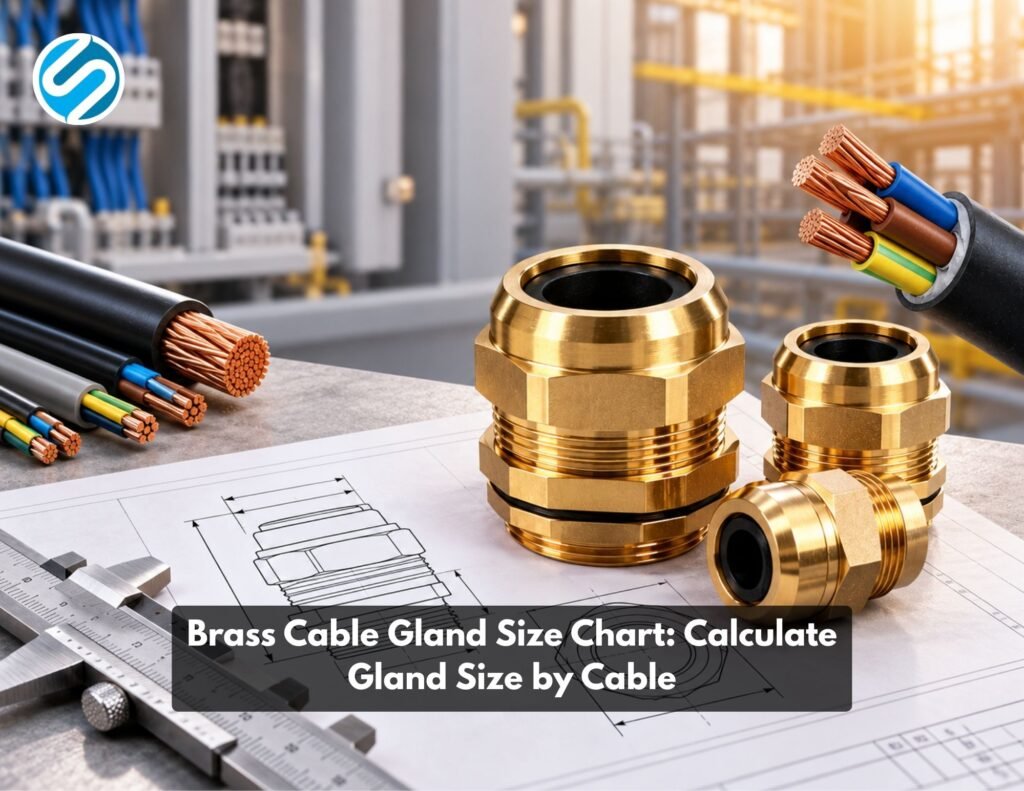
The panel is wired, the cable is pulled, and then the gland nut spins without gripping. Anyone who has worked on a site knows this moment.
Picking the right brass cable gland size sounds simple until the seal won’t close or the cable slips out. One wrong size, and dust, water or vibration gets into your panel. The same sizing discipline applies to most brass fitting parts used in electrical and plumbing work. This guide gives you a working size chart, a step-by-step sizing method, and the mistakes buyers make most often.
What Is a Brass Cable Gland and Why Size Matters
A brass cable gland holds a cable where it enters a panel, motor terminal box or junction box. It grips the cable and seals out dust and moisture. On armoured cables, it also clamps and earths the armour.
Brass is the common choice in India because it machines cleanly, resists corrosion and conducts well for earthing. Most glands are nickel plated, which helps a lot in humid or coastal sites.
Here’s the catch. Every gland works only within a fixed cable diameter range. Get the brass cable gland size wrong, and the seal either won’t compress enough or won’t fit over the sheath at all.
Brass Cable Gland Size Chart (Metric and PG)
The brass cable gland size chart below covers the sizes most often used in Indian panels and machinery. Ranges vary slightly between manufacturers, so always confirm against your supplier’s datasheet.
Metric Thread Sizes
| Gland Size | Thread | Cable Diameter Range (approx.) |
| M16 | M16 x 1.5 | 3 – 8 mm |
| M20 | M20 x 1.5 | 6 – 12 mm |
| M25 | M25 x 1.5 | 10 – 17 mm |
| M32 | M32 x 1.5 | 15 – 24 mm |
| M40 | M40 x 1.5 | 20 – 30 mm |
| M50 | M50 x 1.5 | 25 – 38 mm |
| M63 | M63 x 1.5 | 35 – 50 mm |
| M75 | M75 x 1.5 | 45 – 60 mm |
PG Thread Sizes
| Gland Size | Thread OD | Cable Diameter Range (approx.) |
| PG7 | 12.5 mm | 3 – 6.5 mm |
| PG9 | 15.2 mm | 4 – 8 mm |
| PG11 | 18.6 mm | 5 – 10 mm |
| PG13.5 | 20.4 mm | 6 – 12 mm |
| PG16 | 22.5 mm | 10 – 14 mm |
| PG21 | 28.3 mm | 13 – 18 mm |
| PG29 | 37.0 mm | 18 – 25 mm |
| PG36 | 47.0 mm | 22 – 32 mm |
Metric glands are standard on newer equipment. PG threads still show up on older European machines and some control panels.
How to Calculate Brass Gland Size for Cable
Measure the cable’s overall diameter, then pick the gland whose sealing range covers that number, ideally near the middle. For armoured cable, also check the inner sheath diameter against the gland’s inner seal. Finally, match the entry thread to your enclosure.
If you’ve wondered how to calculate brass gland size for cable without guessing, follow these five steps:
- Get the cable datasheet. It lists overall diameter, inner sheath diameter and armour type.
- Measure if there’s no datasheet. Use a vernier at three points along the cable and take the average.
- Match the overall diameter to the gland’s outer seal range.
- Check the inner sheath if you’re using a double compression gland on armoured cable.
- Match the thread type and length to your panel entry hole and wall thickness.
Skip the datasheet, and you’re guessing your brass cable gland size.
Example: Your datasheet shows an armoured cable with an overall diameter of 25 mm and an inner sheath of 20 mm. M32 tops out at 24 mm, so it’s out. M40 (20–30 mm) puts 25 mm right in the middle, which is where you want it. Now confirm that the M40’s inner seal also covers 20 mm.
That’s really all there is to how to calculate brass gland size for cable: diameter first, thread second, everything else after.
Matching Brass Cable Size and Gland Size
Most buyers in India order cable by sq mm, not by diameter. That’s where brass cable size and gland size get mixed up. Two cables with the same sq mm rating can differ by a few millimetres in diameter, depending on armour, insulation and brand.
So treat any sq mm based table as a starting point only. Before placing a bulk order, check brass cable size and gland size against the actual cable drum you’ll install. For heavy or vertical cable runs, pair the gland with a brass cable gripper so the cable’s weight doesn’t pull on the seal.
When you send a gland inquiry, share these details:
- Cable sq mm, number of cores and armour type (wire or strip)
- Overall diameter and inner sheath diameter
- Entry thread type: metric, PG, NPT or BSP
- Thread length needed for your panel wall thickness
- Finish: natural brass or nickel plated
- Single or double compression
Common Mistakes When Choosing Brass Gland Size
The biggest mistake is ordering by thread size alone. A buyer asks for M25, gets M25, and then finds the cable is 19 mm. The seal won’t grip.
Another common miss is ignoring the inner sheath on armoured cables. The outer seal fits, but the inner seal doesn’t, and the armour isn’t clamped properly.
Then there’s the edge fit. If your cable sits right at the minimum or maximum of a range, the rubber hardens over time and the gland loosens after months of vibration. Choose the brass gland size that keeps your cable near the middle.
And remember, the brass cable gland size also decides the hole you drill in the panel. Drill first and pick the gland later, and you may end up with a loose entry.
Brass Material and Finish: What to Check
Not all brass behaves the same. Glands are usually machined from free cutting brass grades like CW614N, a copper-zinc alloy. If you want to understand where brass fits among other copper-based metals, this guide on types of copper explains it simply. Material grade affects thread strength and corrosion resistance.
Nickel plating works for most electrical jobs. For marine sites or chemical plants, ask about plating thickness too. The brass cable gland size stays the same, but the finish decides how long it lasts outdoors.
Final Word
Getting the brass cable gland size right comes down to one habit: measure the cable, not just the label. Use the chart as a guide, check the datasheet, and keep your cable in the middle of the sealing range. Your panels will stay sealed for years.
FAQs
1. How do I measure cable diameter for a gland?
Use a vernier caliper at three points along the cable and take the average. For armoured cable, note both the overall and inner sheath diameter.
2. What is the difference between single and double compression glands?
A single compression gland seals only the outer sheath. A double compression gland also seals the inner sheath and clamps the armour, so it suits armoured cables.
3. Are PG and metric glands interchangeable?
No. PG and metric threads have different pitch and diameter, so they won’t fit each other’s holes. Use an adapter or reducer if the thread types don’t match.
4. Why are brass glands nickel plated?
Nickel plating protects brass from tarnishing and corrosion, especially in humid or coastal areas. It also gives a clean finish that lasts longer in outdoor installations.
5. Can I use one gland size for different cables?
Only if both cable diameters fall within the same sealing range. Ideally, each cable should sit near the middle of the range for a tight, long-lasting seal.