
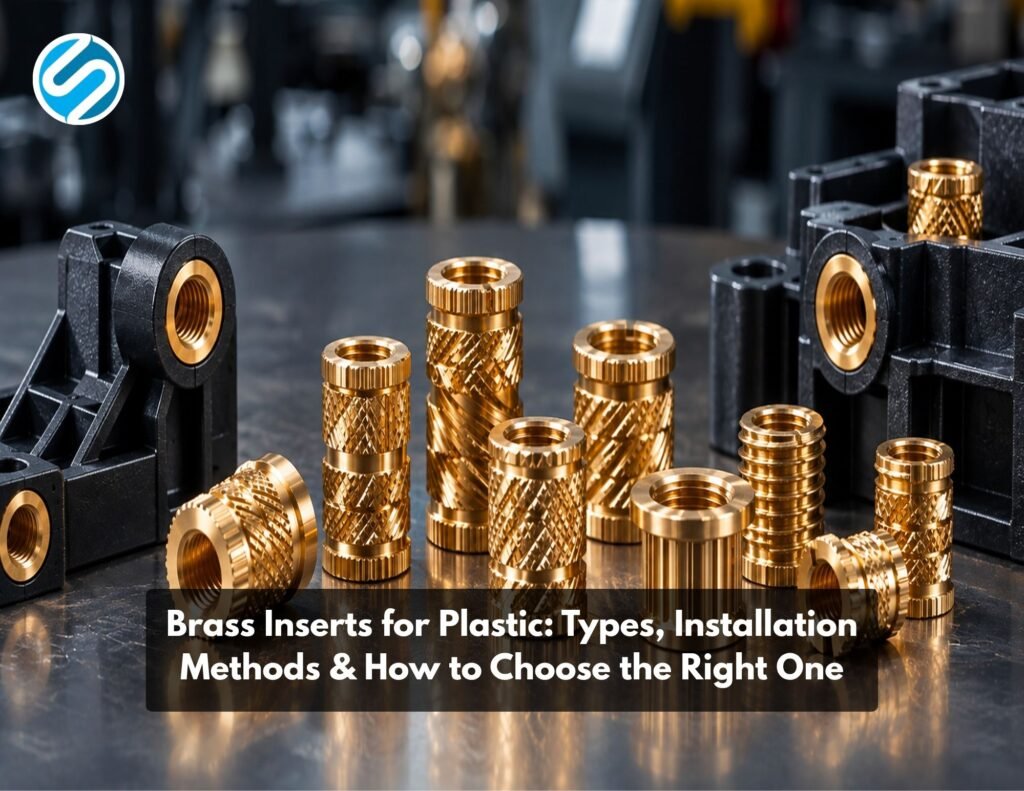
Plastic is light, cheap to mould and easy to shape. But ask it to hold a screw that gets opened and closed fifty times, and it starts to give up. Brass inserts for plastic solve this by giving the part a strong metal thread that does not wear out.
You will find them inside switchboards, CPVC and PPR pipe fittings, mixer grinders, car dashboards and phone chargers. If you design or buy moulded parts in India, knowing how these small components work can save you a lot of rejection and rework.
In this guide, we explain the main types, how each one is installed, and what to check before you place an order. At Suraj Brass Industries in Jamnagar, we make standard inserts as well as Customized Brass Parts for drawing, so the advice below comes from what we see on the shop floor every day.
What Are Brass Inserts for Plastic?
A brass insert is a small threaded bush that sits inside a plastic part. The outside has knurls, grooves or ribs that grip the plastic. The inside carries a machine thread, usually metric like M3, M4, M5 or M6, or an inch thread for export orders.
Once installed, the screw threads into brass instead of plastic, so the joint can be opened and closed many times without damage. That is why metal-threaded inserts are standard in any plastic product that needs servicing.
Why Brass Is the Preferred Material
Steel and aluminium inserts do exist, yet most Indian moulders still prefer brass. Here is why:
- Brass machines cleanly, so threads come out sharp and accurate even in small sizes.
- It does not rust, which matters in humid regions and in bathroom or plumbing products.
- It is a good conductor of electricity and is suitable for use as an earthing or contact point in electrical housings.
- It transfers heat quickly, which makes heat-set and ultrasonic installation faster.
- It grips plastic well without cracking the surrounding wall.
Grade matters too. Most brass inserts are turned from free-cutting brass such as IS 319 or CW614N, which contains a small amount of lead for easy machining. If your product goes into drinking water lines, ask for a lead-free grade instead. A supplier of Premium Brass Components can usually offer both grades.
Types of Brass Inserts Based on Installation
Inserts are grouped by how they go into the plastic. Each suits a different production setup.
Moulded-In Inserts
These are placed in the mould before the plastic is injected. The molten plastic flows around the knurls and locks the insert permanently. They give the highest pull-out strength of any type. CPVC and PPR fitting makers use them widely for threaded female adaptors. The downside is a slower cycle, since an operator or robot has to load each insert.
Heat-Set Inserts
A heated tool pushes the insert into a pre-moulded hole. The plastic around it softens, flows into the knurls and hardens again as it cools. This method is popular for ABS, polycarbonate and nylon. Heat-set threaded brass inserts for plastic are also the usual pick for 3D-printed parts and short production runs.
Ultrasonic Inserts
Here, high-frequency vibration creates heat at the contact point and melts the plastic locally. It takes only a few seconds, which suits large batches of electronic housings. Brass threaded inserts for plastic made for ultrasonic use often have a slightly tapered body so they align themselves in the hole. Buyers in Europe and the US often ask for inch threads and RoHS-compliant brass on these, so confirm both early if your order is part of Brass Items Export.
Press-Fit Inserts
Press-fit inserts are pushed into a hole at room temperature. Straight ribs or diamond knurls bite into the plastic and hold it in place. Installation is cheap and needs only a hand press, but pull-out strength is lower. Use them for light loads, such as covers and panels that are rarely opened.
Choosing the Right Installation Method
The method depends more on your volume and plastic type than on the insert itself. For moulders running lakhs of parts a month, ultrasonic or moulded-in inserts make the most sense. For prototypes or small batches, heat-set is simpler and needs far less investment.
A practical tip: most failures come from the wrong hole size, not a bad insert. If the hole is too big, the insert spins when the screw is tightened. If it is too small, plastic squeezes into the thread and blocks it. Always follow the hole chart for your threaded brass inserts for plastic, and run a small trial batch before full production.
How to Choose the Right Insert for Your Part
Before you finalise a part number or supplier for brass threaded inserts for plastic, go through these points:
- Plastic type: thermoplastics suit heat-set and ultrasonic, while thermosets need moulded-in types.
- Thread size and standard: confirm metric or inch, and the thread class your screw needs.
- Load direction: high pull-out loads need deeper knurls or moulded-in inserts, while high torque needs diamond or straight knurls.
- Wall thickness: leave enough plastic around the insert so the boss does not crack.
- Finish: natural brass works for most uses, and nickel plating helps in damp or corrosive conditions.
- Volume and tolerance: tight tolerances and large orders call for CNC-turned parts.
If you are an Indian OEM shipping finished goods abroad or an overseas buyer sourcing brass inserts from India, ask for material test reports and dimensional reports with every lot. A dependable supplier will also take care of export packing, documentation and RoHS or REACH declarations.
Common Mistakes to Avoid
One frequent error is picking an insert by outer diameter alone and ignoring length. A short insert in a deep boss means the screw bottoms out early. Another is using press-fit types in parts that face vibration, like fan housings or motor covers. These loosen over time, so heat-set or moulded-in types are the safer choice there.
Why Source Inserts from Jamnagar
Jamnagar has been India’s brass hub for decades, with thousands of units handling everything from brass rods to finished turned parts. Working with experienced Brass Manufacturers in Jamnagar gives you shorter lead times, fair pricing and easy access to custom sizes. At Suraj Brass Industries, we make brass inserts in round, hex and custom shapes.
Conclusion
Brass inserts for plastic are a small part of any product, but they decide whether a screw joint lasts one year or ten. Start with your plastic type and production volume, choose the installation method that fits, and then match the thread, knurl and finish to the load. If you need standard or custom inserts made to your drawing, the Suraj Brass Industries team can help you pick the right one for your application.
FAQs
1. What are brass inserts used for in plastic parts?
They give plastic parts a strong, reusable metal thread. They are common in switchboards, CPVC and PPR fittings, appliances and electronic enclosures.
2. Which is better for brass threaded inserts for plastic:heat-set or ultrasonic?
Both give good strength. Heat-set is simpler and cheaper for small and medium batches, while ultrasonic is faster and better suited to high-volume lines.
3. Can brass inserts be used in 3D-printed parts?
Yes. Heat-set types are the most common choice for PLA, PETG and ABS prints.
4. What sizes are threaded brass inserts for plastic available in?
Common metric sizes run from M2 to M10, and inch sizes are available for export orders. Length, outer diameter and knurl type can all be customized.
5. How do I stop an insert from spinning in the plastic?
Check the hole size first. Then use straight or diamond knurls for better torque resistance, and make sure the plastic wall around the insert is thick enough.