
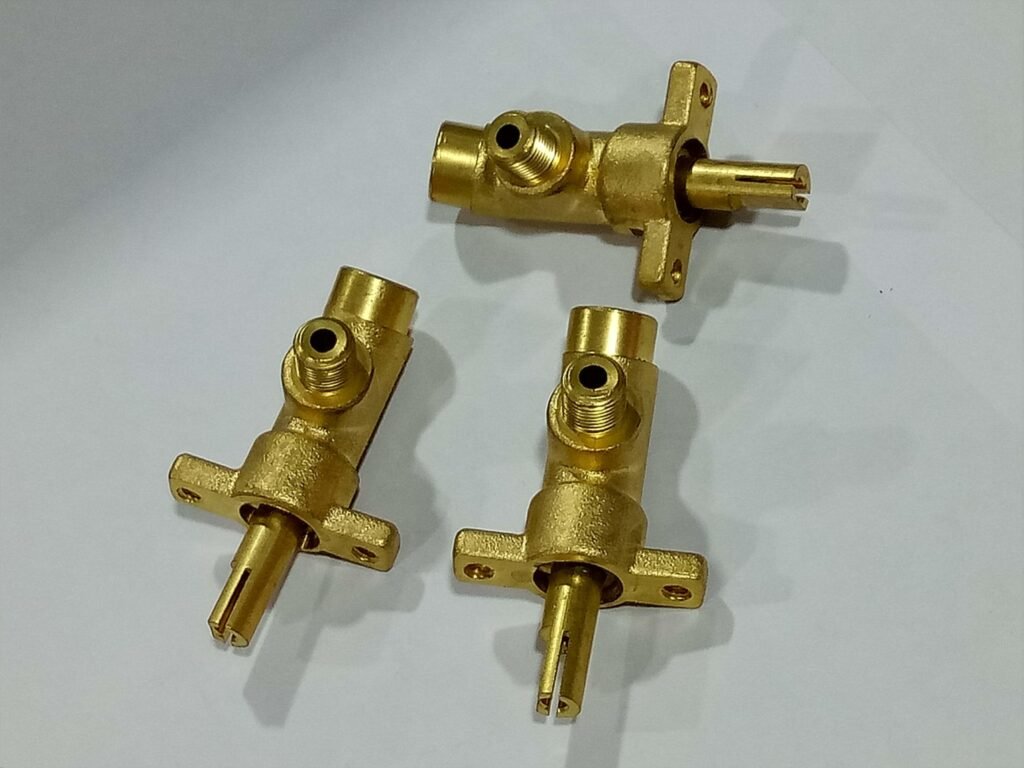
A gas line only needs one weak fitting to turn a small leak into a shutdown. That’s the blunt reason so many plant engineers and stove OEMs specify a Brass gas valve instead of gambling on a cheaper alloy. At Suraj Brass Industries, we’ve spent years machining valves that hold pressure through Jamnagar’s summer heat and European winters alike.
We manufacture and bulk-supply brass gas ball valves for LPG distributors, stove assemblers, industrial gas lines, and export buyers across more than a dozen countries. Every gas valve that leaves our Jamnagar unit is pressure-tested before it’s boxed — not sampled, every single unit, every batch.
Why Brass Beats Other Materials for Gas Applications
Brass resists corrosion from LPG condensate and sulfur compounds better than mild steel, and it machines to tighter tolerances than most alternatives. That’s exactly why the same alloy shows up across our precision lines — from valve bodies to components we supply for Brass Medical Parts, where leak-tight tolerances matter just as much as they do on a gas line.
Steel valves rust from the inside out long before anyone notices — usually right around the seat, where you can’t see it until it’s already leaking. Brass doesn’t have that failure mode. It forms a thin oxide layer and stops there, which is why a properly maintained brass gas valve can outlast the pipeline it’s fitted to.
How We Build a Brass Gas Ball Valve
Our production starts with hot-forged brass billets, not casting shortcuts. Forging aligns the metal’s grain structure, so the valve body handles pressure spikes without the micro-cracking a cast body sometimes develops under repeated thermal cycling and daily temperature swings on site.
After machining, every gas brass valve is fitted with a PTFE seat, assembled by hand, and run through a hydrostatic test at 1.5 times its rated working pressure. Batches that don’t hold pressure for the full test window get scrapped, not reworked.
Key Features of Our Brass Gas Valve Range
- Full-bore and reduced-bore ball designs for higher flow with less pressure drop
- BSP, NPT, and BSPT threading options to match regional pipeline standards
- PTFE seats rated for LPG, CNG, and industrial gas lines
- Nickel-plated and natural brass finishes for corrosion-prone environments
- Sizes from 1/4 inch to 2 inches, with custom bore sizes on request
We also produce a dedicated brass gas stove valve line for OEMs building domestic and commercial cooking equipment. It runs a smaller bore and lower operating pressure than our industrial range, but goes through the same hydrostatic test standard.
How LPG Gas Is Produced and Why It Changes What a Valve Has to Survive
Where LPG’s Impurities Actually Come From
LPG comes from two sources: natural gas processing, where propane and butane are separated from raw gas through refrigeration, and crude oil refining, where fractional distillation pulls the same hydrocarbons out of petroleum. Roughly six in ten tonnes worldwide trace back to gas processing rather than refineries, and we manufacture precision-turned Brass Bushes for buyers who need that same corrosion resistance elsewhere in their equipment.
Once you understand how LPG gas is produced, the valve-material question stops being academic. Gas-processed LPG carries faint mercaptan traces and condensation moisture; refinery-sourced LPG carries leftover sulfur compounds that a cheaper alloy simply can’t shrug off for long.
Why the Chemistry Matters for Valve Material
Whatever’s flowing through the line eventually touches the valve seat, and that’s the part most buyers forget to spec for when they’re only comparing price per unit. A cheap valve doesn’t fail on day one — it fails eighteen months in, once trace moisture has worn a groove into a seat that a brass gas valve is built to resist.
Buyers who ask how LPG gas is produced are usually trying to figure out valve wear, not chemistry for its own sake, and a gas brass valve handles both refinery-sourced and gas-processed impurities without the pitting that ruins cheaper alloys. One export client switched their entire spec after replacing corroded fittings twice in a single winter; the replacement order hasn’t come back once in three years.
Where a Gas Valve Actually Gets Used
Common Applications Across Industries
Buyers rarely need just one valve type. A single LPG bottling plant might order full-bore ball valves for the main manifold, a brass gas stove valve for pilot lines, and smaller shut-off valves for maintenance points — all from one supplier, one quality standard.
- LPG cylinder filling and bottling plants
- Domestic and commercial gas stove manufacturing
- CNG dispensing stations and industrial gas piping
- Medical and laboratory gas supply lines
- Water heater and boiler gas control assemblies
Why Export Buyers Standardize on One Spec
Export buyers in the UK, Australia, and the Gulf typically standardize on one gas brass valve spec across all of these applications rather than sourcing different valves for each use case. It simplifies their own quality documentation, and it’s one reason our repeat-order rate on bulk contracts runs high.
Bulk Supply, Custom Specs, and Export Readiness
Meeting Container-Load Orders
Bulk buyers don’t want a catalog page — they want a supplier who can hold a spec across 50,000 units the same way they hold it across 500. We quote by container load, support private labeling, and adjust thread standards, bore size, and finish per market without retooling delays.
A brass gas valve batch built for a UK buyer ships with BSP threads and British-standard paperwork; the same valve for a US buyer ships NPT-threaded with different certification documents.
Specification | Standard Range |
Valve size | 1/4″ to 2″ |
Thread standards | BSP, BSPT, NPT |
Working pressure | Up to 25 bar (363 psi) |
Test pressure | 1.5x rated (hydrostatic) |
Seat material | PTFE |
Body material | CW617N / C37700 brass |
Documentation, Packaging, and Payment Terms
Every gas valve batch ships with a material test certificate and a hydrostatic test report, because export buyers in regulated markets won’t clear customs without one. Lead times run four to six weeks for standard container orders, shorter for repeat buyers on an existing spec.
Packaging is its own line item buyers underestimate. Ours ships in individual poly sleeves inside partitioned cartons, palletized to the buyer’s container plan rather than ours — the difference between a ten-minute inspection and an afternoon one. We work with letters of credit, advance payment, and staged payment on repeat contracts.
Quality Testing Before a Single Unit Ships
The Three Checks Every Valve Goes Through
Every valve — whether it’s a full industrial valve or a smaller brass gas stove valve — goes through hydrostatic pressure testing, dimensional inspection against drawing tolerances, and a visual finish check. We reject at the batch level, not the unit level, because one bad valve in a shipment is a relationship problem, not just a returns problem.
Ball and Seat Inspection
The ball itself gets separate attention on every check. It’s chrome-plated after machining to cut friction against the seat, and plating thickness is sampled from every production run rather than trusted to the plating vendor’s own paperwork. A rough surface doesn’t show up in a five-minute check — it shows up eighteen months later as an untraceable leak.
Whatever leaves our floor — a bulk brass gas valve order or a one-off custom run — goes through that same sign-off before it’s packed. It’s mostly discipline: the same three checks, run the same way, whether the order is 500 units or 50,000.
That same discipline carries across our other product ranges, including finish-critical work like Brass Decorative Parts, where a plating flaw is just as unacceptable as a pressure failure on a brass gas valve. It’s the same factory floor and the same inspection standard, whatever’s on the line that day.
Conclusion
A brass gas valve isn’t a commodity part, even though it gets priced like one on a spreadsheet. The alloy, the forging, and the testing standard behind it decide whether a valve lasts five years or fifteen. That’s the standard we hold every batch to at Suraj Brass Industries.
FAQs
Q1: Is brass better than steel for gas line valves?
Yes, for most gas applications. Brass resists corrosion from LPG condensate and sulfur compounds far longer than mild steel, and it doesn’t need a protective coating that can wear off over years of use.
Q2: What pressure rating does a standard brass gas valve need for LPG?
Most domestic and commercial LPG lines run well under 5 bar, but our valves are rated up to 25 bar and hydrostatically tested at 1.5 times that rating to build in a safety margin.
Q3: Can you supply custom thread standards for export orders?
Yes. We manufacture BSP, BSPT, and NPT threaded valves to match the plumbing standards of the destination market, along with private labeling and market-specific certification paperwork.