
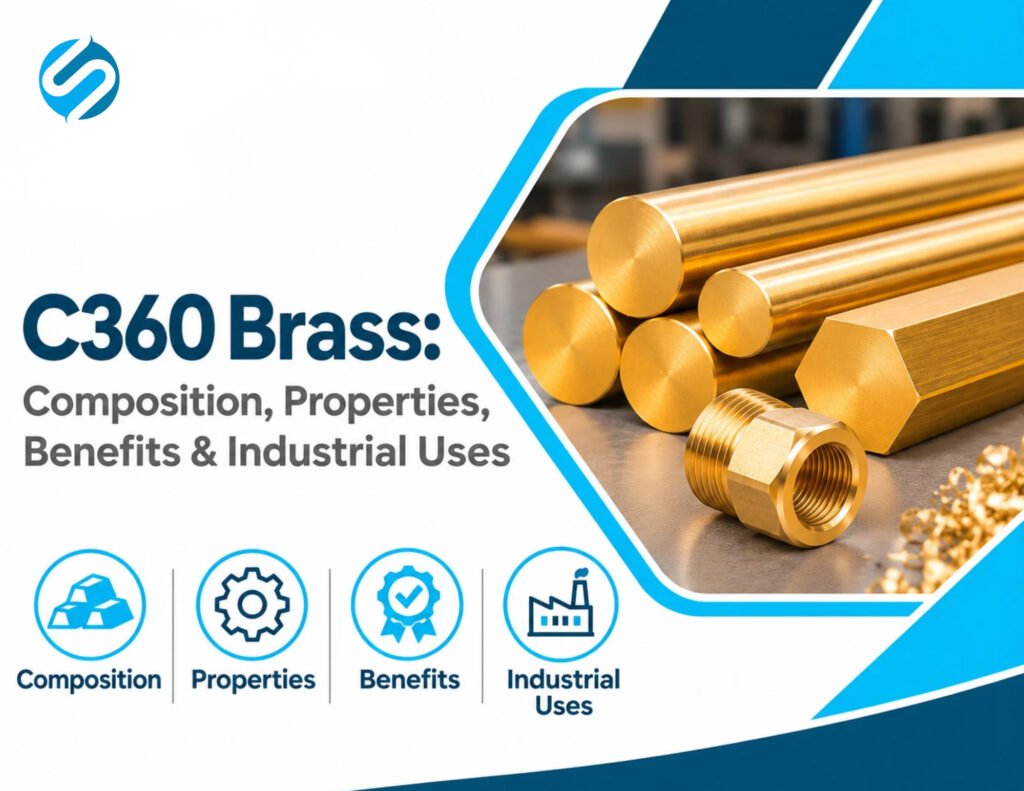
If you’ve ever held a brass valve spindle, a gas fitting or a small electrical pin, it was probably machined from C360 brass. Engineers call it free-cutting brass because it machines faster and cleaner than almost any other copper alloy. In India it’s one of the most ordered grades for turned and precision parts.
This guide covers what goes into the alloy, how strong and hard it is, where it works well and where it doesn’t. If you buy or design brass turned components, it will help you pick the right material and talk to your supplier with confidence.
Understanding Copper C360 Brass
C360 is a leaded yellow brass. Its full UNS number is C36000, and you’ll also see it called CDA 360 or free-machining brass. It has a machinability rating of 100, and every other copper alloy is measured against that number.
Buyers often search for copper C360 brass because the alloy is mostly copper. The copper gives it corrosion resistance and conductivity, zinc adds strength, and lead makes the chips break into small pieces during cutting. Those small chips are why CNC shops love it.
C36000 Brass Composition
The C36000 brass composition is controlled under ASTM B16. A typical mill test certificate will show values like these:
| Element | Percentage (%) |
| Copper (Cu) | 60.0 – 63.0 |
| Lead (Pb) | 2.5 – 3.0 |
| Iron (Fe) | 0.35 max |
| Zinc (Zn) | Balance (about 35.5) |
The lead doesn’t dissolve into the metal. It stays as tiny particles spread through the structure, and they act like built-in chip breakers. That’s why the C36000 brass composition matters so much on the shop floor: too little lead shortens tool life, and too much lowers strength.
Practical tip: Ask for a mill test certificate with every lot of rod. Rod from a cheap source with no paperwork can have the wrong lead content, and you usually find out only when tools start wearing fast or parts crack.
Mechanical Properties and C360 Brass Tensile Strength
C360 brass tensile strength depends on the temper. Half-hard rod is the most common form and usually tests at about 400 MPa (58 ksi), with a yield strength near 310 MPa. Soft annealed material is lower, at about 340 MPa.
That’s plenty for most fittings, fasteners and valve parts. If a part takes heavy shock or impact loads, a stronger alloy or steel may be the better choice. Check C360 brass tensile strength against your load calculation before you finalise the drawing.
C36000 Brass Hardness and Physical Properties
In half-hard condition, C36000 brass hardness is about 78 on the Rockwell B scale. That makes it harder than pure copper but soft enough that cutting tools move through it easily.
C36000 brass hardness also stays fairly consistent from batch to batch. That helps with tight-tolerance work, because the tool behaves the same way across a long production run.
| Property | Typical Value |
| Density | 8.50 g/cm³ |
| Melting range | 885 – 900 °C |
| Tensile strength (half hard) | ~400 MPa |
| Yield strength (half hard) | ~310 MPa |
| Hardness (half hard) | ~78 HRB |
| Electrical conductivity | ~26% IACS |
| Machinability rating | 100 |
C3604 Brass: The Japanese Equivalent
Many Indian exporters get drawings from Japanese and other Asian buyers that call for C3604 brass. It’s the JIS H3250 grade and is very close to C360. Copper runs from 57% to 61% and lead from 1.8% to 3.7%, so it carries a little more zinc.
| Grade | Standard | Copper (%) | Lead (%) |
| C36000 | ASTM B16 (USA) | 60.0 – 63.0 | 2.5 – 3.0 |
| C3604 | JIS H3250 (Japan) | 57.0 – 61.0 | 1.8 – 3.7 |
In practice the two machine almost the same way. Still, confirm in writing that the buyer accepts C3604 brass as a substitute. The copper ranges differ, and some customers check this during inspection.
Key Benefits
The reasons copper C360 brass stays popular are practical:
- Excellent machinability: shorter cycle times and lower tooling cost per part.
- Good corrosion resistance: holds up well in air, fresh water and many industrial fluids.
- Clean surface finish: parts often come off the machine ready to use, without polishing.
- Useful conductivity: works well for electrical pins, terminals and connectors.
- Non-sparking and non-magnetic: safe for gas fittings and sensitive equipment.
- Easy to plate: takes nickel, chrome and tin plating well.
- Fully recyclable: brass scrap has strong resale value, which offsets material cost.
Industrial Uses
Most manufacturers pick C360 brass when a part has threads, small holes or fine details that need to be cut quickly. Common uses include:
- Plumbing and sanitary fittings, nipples and adaptors
- Gas valve bodies and regulator parts
- Electrical terminals, earthing parts and cable glands
- Automotive sensor housings and fuel-system parts
- Lock cylinders, keys and hardware
Jamnagar in Gujarat makes a large share of India’s brass parts, and most of those turned and brass precision components start as free-cutting brass rod.
Where to Be Careful
Because the alloy contains lead, it isn’t the right choice for drinking water parts in markets with strict lead-free rules, such as the USA. For those orders, use a lead-free brass grade instead.
It also doesn’t weld well and cracks if bent hard when cold. If your part needs heavy forming, a forging brass is the better fit. For a wider look at what can be made from different alloys, this guide on Brass Materials is a useful reference.
Before you place a bulk order, ask for a sample batch. Measure threads, check the surface finish and run a simple pressure test if the part carries gas or water.
Finally, agree on the grade, temper and standard in your purchase order. One clear line like “ASTM B16, half hard” prevents most disputes later.
Conclusion
C360 brass is the standard alloy for fast, accurate machining. It’s easy to cut, resists corrosion, finishes cleanly and is strong enough for most fittings and fasteners. Know its composition, strength and limits, match it to the right job, and you’ll get better parts at a lower cost.
FAQs
1. Why is C360 called free-cutting brass?
About 3% lead breaks chips into small pieces, so tools cut faster and last longer.
2. Can C360 be used for drinking water fittings?
Not in markets with lead-free rules. Use a lead-free brass grade for potable water parts.
3. Is C3604 the same as C36000?
They’re close but not identical. C3604 allows a wider lead range and slightly less copper.
4. Can free-cutting brass be welded?
It isn’t recommended, because the lead causes cracking. Use threading, brazing or crimping instead.
5. What is the density of C36000?
About 8.50 g/cm³, which is slightly lower than pure copper.