
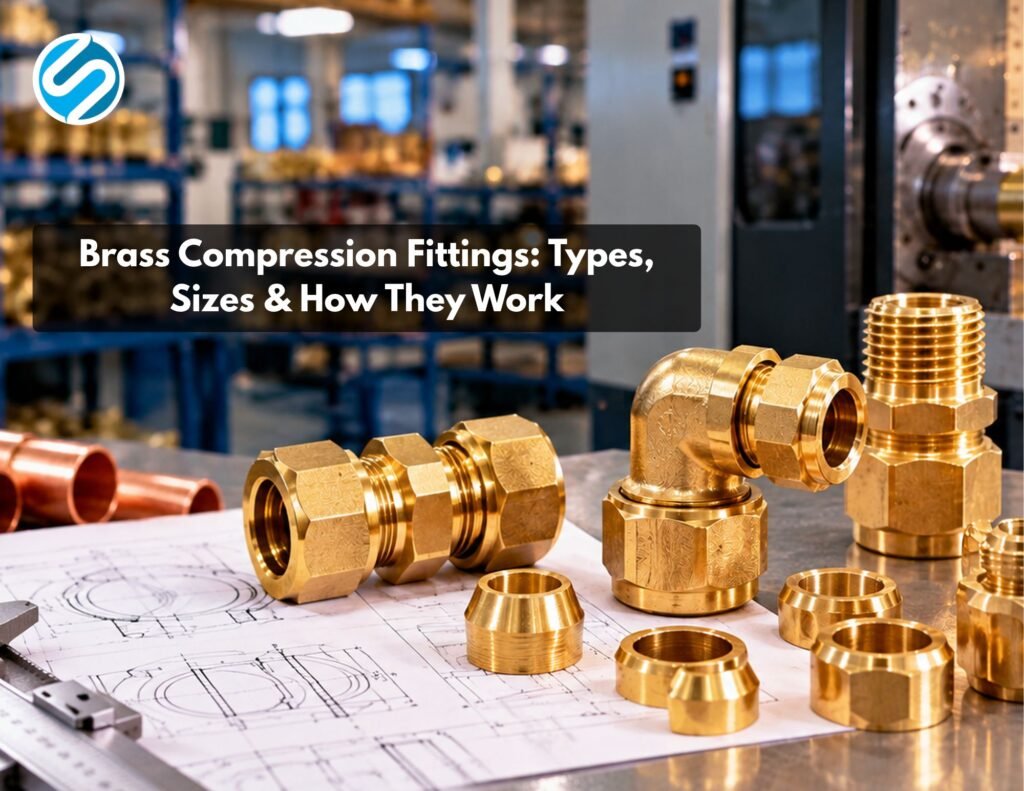
Not every pipe joint needs a blowtorch. In homes, factories and workshops across India, plumbers and engineers use brass compression fittings to connect pipes quickly, cleanly and without any soldering or welding. Tighten a nut with two spanners, and the joint is ready.
They are everywhere once you start looking: under kitchen sinks, behind geysers, inside RO water purifiers, on air lines in workshops and on instrument panels in process plants. Most people never think about them until one starts to drip.
In this guide, we explain how these fittings are built, the main types and sizes, and what to check before you buy. At Suraj Brass Industries in Jamnagar, we manufacture Brass Fitting parts for plumbing and industrial buyers, so this advice comes straight from our machining floor.
What Are Brass Compression Fittings?
A compression type fitting joins two pipes or tubes by squeezing a soft metal ring onto the pipe wall. There is no heat, no glue and no thread cut on the pipe itself. This makes it ideal for places where soldering is unsafe or simply not practical.
Open up any compression type fitting and you will find the same few pieces inside:
- Body: the main brass part. The pipe slides into it from one or both ends.
- Nut: screws onto the body and does the real work, pushing the ring forward as you tighten it.
- Olive or ferrule: a small brass or copper ring that clamps around the pipe.
- Seat: the sloped face inside the body. The olive presses against it to make the seal.
- Pipe insert: only needed for soft plastic or PEX pipes, so the pipe does not squash flat.
Brass is the most common material for the body and nut. It machines accurately, resists corrosion in water and holds a thread well even after repeated tightening. If you need non-standard bodies or special nuts, our article on High-Quality Brass Parts explains how custom orders are handled.
How Do Compression Fittings Work?
The idea is simple. When you tighten the nut, it pushes the olive against the tapered seat inside the body. As it squeezes inward, the olive bites into the pipe and holds it firmly. It also gets pressed hard against the seat on one side and the nut on the other, so water has nowhere to escape.
So, how do compression fittings work without any sealant? The seal comes from metal pressing on metal. The olive deforms just enough to fill tiny gaps, which is why a properly fitted joint can hold water pressure for years.
A practical tip: do not overtighten. Most fitters go hand-tight first and then add about half to one full turn with a spanner. Too much force crushes the olive and causes the very leak you are trying to avoid. Also, cut the pipe square and remove burrs before fitting, as a rough edge is the most common reason for a slow drip.
Types of Compression Fittings
The type you pick depends on what the joint needs to do. Here are the ones you will see most often in Indian plumbing and industrial work.
Straight Coupling
Joins two pipes of the same size in a straight line. This is the most common type for repairs and extensions.
Elbow
Turns the pipe at 90 degrees. Useful along walls, under sinks, and in tight corners.
Tee
Creates a branch so one line can feed two outlets, such as a geyser and a basin.
Reducer
Connects pipes of two different sizes, for example, 22 mm to 15 mm.
Male and Female Connectors
One end takes the pipe through compression, while the other end has a BSP or NPT thread to connect to a valve, tap or tank.
Union
Allows a section of pipe to be taken apart later without cutting, which helps during maintenance.
Compression Fitting Sizes
Size always refers to the outside diameter of the pipe, not the inside. This is where many buyers make mistakes. For example, a 15 mm copper line feeding a bathroom geyser needs a 15 mm fitting, even though the bore of that pipe is narrower. Ordering by inner diameter is how many site teams end up with a full box of parts that do not fit.
In India, metric sizes such as 6 mm, 8 mm, 10 mm, 12 mm, 15 mm and 22 mm are common for copper and PEX lines. For export orders to the US, inch sizes like 1/4″, 3/8″ and 1/2″ tube OD are standard. Threaded ends usually follow BSP for Indian, UK and Gulf markets and NPT for American buyers.
Before ordering, measure the pipe’s outer diameter with a vernier, confirm the thread standard on the connecting side, and check the working pressure your line needs. For a wider look at how brass fits into plumbing systems, read our guide on Brass Piping and Fittings.
How to Choose the Right Supplier
Many plumbers simply search for brass fittings suppliers near me and buy whatever the local shop has in stock. That works for a quick repair, but for project or OEM orders, quality and consistency matter much more. Before you place a bulk order, check these points:
- Brass grade and lead content, especially for drinking water lines.
- Thread accuracy on the body and nut, checked with proper gauges.
- Olive material and finish, since a rough olive will not seal well.
- Pressure testing of sample lots before dispatch.
- Plating options such as nickel or chrome for visible or corrosive areas.
- Packing that protects threads during transport.
Reliable brass compression fittings manufacturers will share test reports and samples without hesitation. Searching for brass fittings suppliers near me is a fine starting point, but always ask where the parts are actually made.
Why Source from Jamnagar?
Jamnagar produces a large share of India’s brass parts, from small turned components to complete fitting assemblies. Buyers here get shorter lead times, fair pricing and the option to customise sizes and threads. Many brass compression fittings manufacturers in the city also handle export documentation for Gulf, European and US customers.
If you need fittings made to your drawing or in mixed sizes, working directly with an experienced Brass Components Manufacturer saves both cost and back-and-forth with traders.
Conclusion
Brass compression fittings are small, but they keep water, air and gas lines running without leaks. Pick the right type for the job, match the size to the pipe’s outer diameter, and tighten with care instead of force. For bulk or custom orders, work with a manufacturer who tests every batch and can supply a consistent quality order after order.
FAQs
1. Is a compression type fitting reusable?
Mostly, yes. You can reuse the body and nut, but the olive gets squashed onto the pipe the first time, so fit a new one whenever you redo the joint.
2. How do compression fittings work on plastic pipes?
Pretty much the same as on copper. The only extra step is pushing a pipe insert into the plastic pipe first, so it keeps its shape when you tighten the nut.
3. Do I need PTFE tape on a compression joint?
Not on the olive. That seal is metal against metal, and tape can actually stop it seating properly. Use tape only on the threaded end going into a tap or valve.
4. What should I ask brass compression fittings manufacturers before ordering?
Ask which brass grade they use, which thread standard they follow, whether they pressure test each lot, what plating they offer and what their minimum order is.
5. How do I find reliable brass fittings suppliers near me?
A local hardware dealer is fine for a few pieces. For bulk or project orders, go straight to a manufacturer and ask for samples and test reports first.