
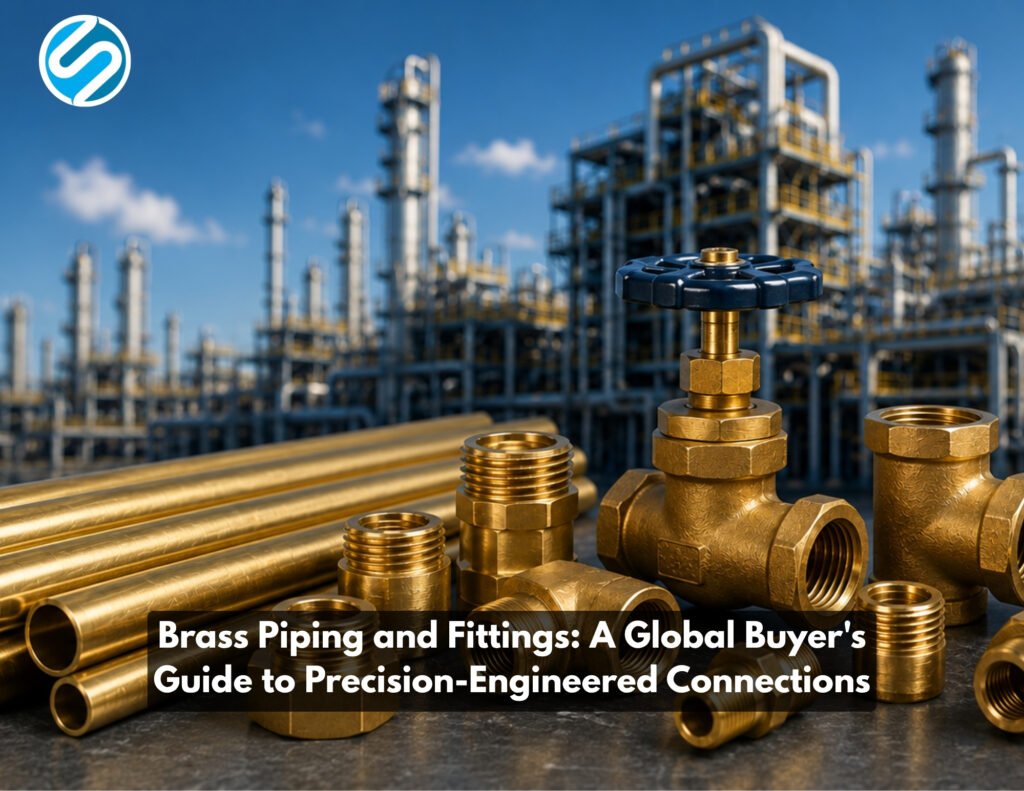
Every plumbing system, from a two-story apartment block to a chemical processing plant, lives or dies on its connections. A pipe run is only as good as the joint holding it together. That is the entire reason brass piping and fittings still dominate serious plumbing and industrial work after more than a century of alternatives coming and going.
Contractors trust them. Project managers specify them by default. Importers keep reordering them because customers rarely call back with complaints.
At Suraj Brass Industries in Jamnagar, we manufacture and export brass piping and fittings to plumbing wholesalers, hardware distributors, and OEM buyers across the Middle East, Europe, Africa, and Southeast Asia. This guide covers why brass earns its reputation, which components matter most in a typical order, how sizing affects performance, and what quality checks separate a fitting that lasts from one that gets returned.
Why Choose Brass for Piping & Industrial Applications?
Brass is a copper-zinc alloy, and that composition is what gives it the properties plumbing engineers actually care about. It resists corrosion in a way mild steel and even some grades of stainless cannot match. It also machines cleanly, so threads come out sharp and consistent, batch after batch.
That consistency is why a brass pipe fitting from one production run seals the same way as one from a run six months later. Buyers sourcing brass pipe fittings for large projects tend to weigh a short list of factors before they commit to a supplier:
- Corrosion resistance that holds up in humid coastal climates, hard water regions, and mildly acidic or alkaline fluid lines without pitting or scaling.
- High tensile strength relative to weight, so fittings handle vibration and thermal stress in industrial piping without cracking at the joint.
- Temperature tolerance across a wide operating range, from cold-water domestic supply to hot-water and steam applications.
- Machinability and dimensional accuracy, which keeps thread engagement consistent and reduces leak call-backs.
- Long service life, since brass does not go brittle with age the way some plastics do, and it skips the cathodic protection steel piping often needs.
For a plumbing contractor working on a tight deadline, that reliability is worth more than a marginally cheaper alternative that might need replacing in five years.
Essential Types of Brass Piping & Fittings
A single plumbing or process line rarely uses just one component. Most jobs combine several types of brass components to route, join, reduce, and terminate pipe runs cleanly.
Buyers searching online for these parts do not always use the same terminology. Some ask for a brass connector, others search for brass couplings, brass pipe connectors, or brass adapters. A fair number simply type in pipe connector brass parts by size rather than by name.
They are usually describing the same catalogue of brass pipe fittings, just filtered through whatever term their local market happens to use. When we quote an order, we confirm the exact part against a drawing or sample rather than relying on the name alone, since a brass connector to one buyer might simply mean a coupling to another.
A typical bulk order for brass piping and fittings pulls from this shortlist:
- Elbows and tees for direction changes and flow splits
- Couplings to join or reduce straight pipe runs
- Pipe nipples to connect fittings or extend a run
- Compression fittings for serviceable, solder-free joints
- Hex nipples and bushes to step between thread sizes
Brass Elbows and Tees
Elbows change the direction of a pipe run, usually at 45 or 90 degrees. Tees split or combine flow at a junction. Both are among the most ordered SKUs in any batch of brass tees and elbows because almost no real-world layout is a straight line.
Wall thickness and thread depth matter more here than buyers often expect. A thin-walled elbow under pressure is where leaks tend to start first.
Brass Couplings
A coupling joins two lengths of pipe in a straight run or steps between two different pipe sizes as a reducing coupling. They look simple, but a poorly machined coupling with slightly off-center threads will never seat evenly.
Brass Pipe Nipples
A brass nipples is a short piece of pipe threaded on both ends, used to connect two fittings or extend a run. Hex nipples add a hexagonal grip section for tightening without damaging the threads.
They show up constantly in valve assemblies, water heater connections, and gas lines. Any distributor stocking brass pipe nipples in volume knows these move faster than almost anything else in the catalogue.
Brass Compression Fittings
Compression fittings join pipe without soldering or threading into the pipe wall itself. A ferrule compresses around the tube when the nut is tightened, creating a mechanical seal that can be taken apart later.
For OEM manufacturers, we also work as a custom brass components manufacturer, machining fittings to drawing specifications rather than standard catalogue sizes. This matters most for buyers integrating brass pipe compression fittings into proprietary equipment, where a half-millimeter tolerance difference can mean the part does not fit the housing at all.
Hex Nipples and Bushes
A hex bush, sometimes called a brass bush, reduces from a larger thread size to a smaller one. It lets installers step down pipe diameter at a valve or appliance connection without swapping the whole run.
Paired with hex nipples, brass bushes handle most size transitions a plumbing system needs. A well-stocked brass bush range is often what separates a distributor who can fill an order the same week from one who cannot.
Across all of these parts, buyers ordering brass piping and fittings tend to standardize on two or three preferred sizes for each type, which keeps stock simple and speeds up quoting on repeat orders.
Navigating Pipe Layouts & Sizes
Getting the fitting right on paper does not guarantee a leak-proof connection on site. Thread type has to match across the entire run, because BSP and NPT threads look similar but are not interchangeable.
Flow rate matters too. Undersized fittings restrict throughput and create pressure drops, while oversized components waste material cost without adding real benefit.
A buyer specifying brass plumbing fittings for a multi-story building or an industrial pipeline should map the full layout before ordering. That means checking a few things up front:
- Number of direction changes and junctions in the run
- Where pressure zones split, and by how much
- Which sections carry hot water versus cold
- Where future maintenance access will be needed
Getting this mapped out early avoids expensive mid-project substitutions.
|
Thread Standard |
Common Region |
Typical Use Case |
Notes |
|
BSP (British Standard Pipe) |
UK, Middle East, India, Africa |
Domestic and commercial plumbing |
Parallel (BSPP) or tapered (BSPT); not compatible with NPT |
|
NPT (National Pipe Thread) |
North America |
Plumbing, gas, hydraulic lines |
Tapered thread seals on the flank |
|
DIN |
Europe |
Industrial and process piping |
Often specified alongside ISO |
|
ISO 228 / ISO 7 |
Global |
Export orders, OEM assemblies |
Reference standard for harmonizing BSP threads |
Getting the thread standard wrong is rarely a manufacturing defect. It is almost always a specification mismatch caught too late, which is why we confirm thread type, size, and pressure rating with every export client before production starts.
Quality Standards & Global Export
Every fitting that leaves our Jamnagar facility goes through thread gauge checks and pressure testing before it is packed for shipment. Thread gauging confirms the pitch and diameter sit within tolerance.
Pressure testing confirms the part holds under the load it will actually see in service, not just under a lighter benchtop check.
Compliance matters as much as the physical testing. Export orders are built to BSP, NPT, ISO, and DIN standards depending on the destination market. A fitting that passes inspection in one country can fail a review in another if the thread standard is not documented correctly.
A few things buyers should confirm before an export shipment ships:
- Mill test certificates for alloy composition
- Thread gauge and pressure test records for the batch
- The specific standard used (BSP, NPT, ISO, or DIN)
- Packaging suited to the destination climate and transit time
We supply brass piping and fittings for water utilities, HVAC contractors, and industrial pipeline projects, including large-scale runs similar to the ones covered in this piece on Industrial Pipeline Systems.
Conclusion
If you are a wholesaler, contractor, or OEM buyer looking to source brass piping and fittings at scale, Suraj Brass Industries can quote against your exact specification. That includes catalogue brass nipples, compression fittings, or fully custom components machined to drawing.
Reach out to our export team at info@surajbrassindustries.com or through: www.surajbrassindustries.com to request a bulk quote or ask for samples ahead of a full production run. We have supplied precision brass components to global buyers for years, and we would rather answer your sizing questions now than deal with a return shipment later.
Whether your purchase order lists a brass nipple by part number, calls out brass pipe connectors and brass adapters for a mixed shipment, or simply asks for pipe connector brass parts in a given size range, send us the specification. We will confirm stock and lead time before you commit to the order.
FAQs
BSP is common in the UK, India, the Middle East, and Africa. NPT is standard in North America. They are not interchangeable, and mixing them almost always leaks.
A properly installed fitting in a domestic or commercial water line commonly lasts several decades. Harsh industrial conditions shorten that somewhat, but brass still outperforms most alternatives.
Sometimes, if the ferrule shows no damage. Most contractors replace it on reassembly anyway to guarantee a reliable seal.
Yes. As a custom brass components manufacturer, we machine to drawing specifications, including nonstandard thread pitches and hex profiles.
Ask for mill test certificates and batch-level thread gauge and pressure test records. Confirm the standard, BSP, NPT, ISO, or DIN, matches your market.
Yes. Many distributors start with a mixed pallet of brass plumbing fittings, a range of brass pipe fittings, and a brass bush or two, before scaling to full container loads.