
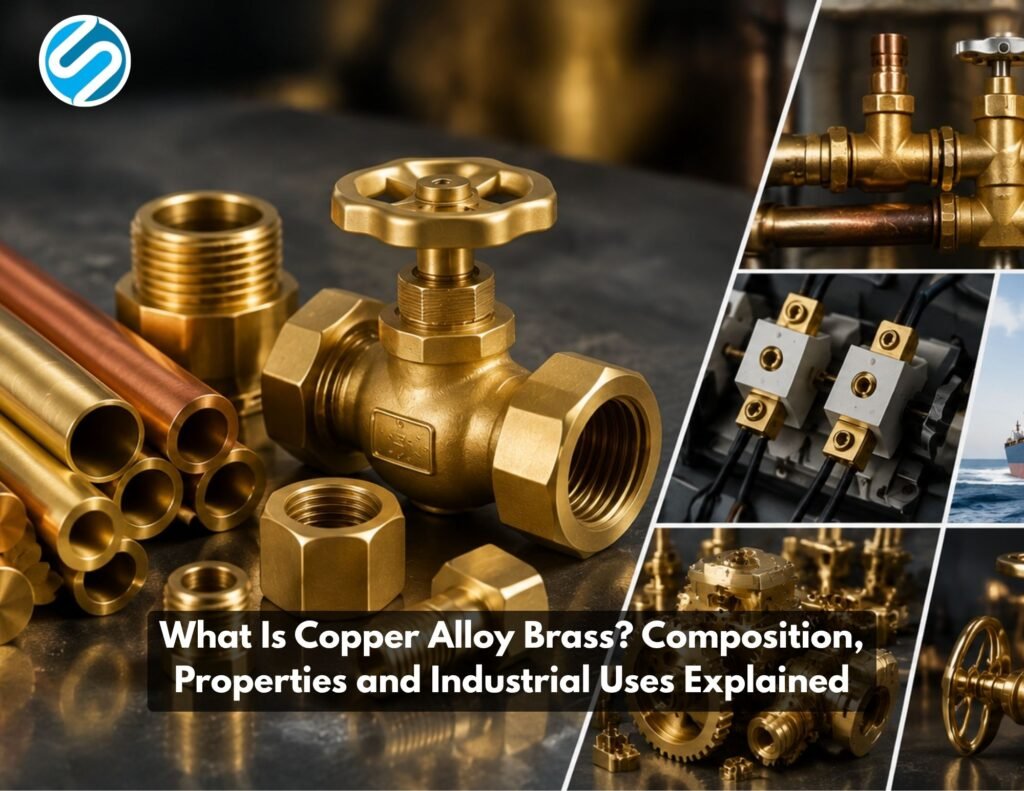
Copper Alloy Brass finds application in a variety of industries. Its importance can be gauged from the fact that it is one of the metals that is extensively used. So, what is the copper alloy brass? This article will provide an answer to that and a lot more by analysing its properties and its industrial applications.
What Is Copper Alloy Brass?
Copper Alloy Brass is an alloy consisting of Copper and Zinc. The proportions of Copper and Zinc for any brass alloy is not fixed. It is said that the ratios of Copper and Zinc for any brass alloy is about 60:40 and 90:10. Anything outside that is said to be a different brass alloy.
Brass is better than Copper in many aspects when it comes to copper-based alloys. These include increased strength and better resistance to corrosion. Also, it is used for making precision parts due to ease of machining. It is also one of the many alloys made from copper and is allied to bronze, cupronickel, etc. — the same product family that copper brass and bronze alloys suppliers serve across global industrial markets.
Understanding how much copper is present in brass is essential when selecting the right grade for industrial use. The trade-off for better resistance, however, is the strength and toughness of the brass. These are improved with Zinc.
How Are Brass and Copper Related?
First, it’s important to understand the origin of brass as an alloy. Copper is the primary metal here — brass cannot exist without it. How are brass and copper related? A straightforward answer is that brass is an alloy of copper, which consists of molten copper combined with zinc. The process is controlled so that the resulting alloy retains useful intrinsic properties of copper and takes advantage of the benefits introduced by zinc.
For this reason, brass and copper are usually discussed in tandem in materials science, metallurgy, and industrial procurement. Both brass and copper exhibit excellent thermal and electrical conductivity and possess intrinsic antimicrobial properties, in addition to the fact that both metals are highly recyclable. Brass, however, shows an advantage over copper when it comes to structural integrity and mechanical properties.
If you want a background in the chemistry of the base material and the alloy, check out our complete line of Brass Components.
Composition of Copper Alloy Brass
Standard Grades and Their Copper Content
Different brass grades serve different industrial needs. Here is a breakdown of common grades and how much copper is present in brass for each:
- Cartridge Brass (C260) — 70% copper, 30% zinc. This grade is very ductile and is used to make ammunition and other deep-drawn components.
- Naval Brass (C464) — 60% copper, 39.2% zinc, 0.8% tin. This grade has excellent corrosion resistance to the sea.
- Free-Cutting Brass (C360) — 61.5% copper, 35.5% zinc, 3% lead. This is the best machining brass and is suitable for making parts that are turned with precision.
These grades are supplied globally by copper brass and bronze alloys suppliers who cater to industries ranging from electrical engineering to construction and automotive.
Key Properties of Copper Alloy Brass
Why This Alloy Stands Out
Brass is formulated to provide an excellent blend of physical and mechanical parameters; certain characteristics of brass allow it to be irreplaceable in many industries, such as the following:
- Machinability — Brass is more easily machined than most metals and causes very little abrasion to cutting tools, so the consumption cost is low.
- Corrosion Resistance — Brass does not corrode in water or air or in contact with many chemicals. This feature of brass makes it useful in plumbing and marine work and for outdoor applications.
- Electrical and Thermal Conductance — due to its high copper content, brass is an alloy with good electrical and thermal conductance.
- Ductility and Formability — Brass is very ductile and can be drawn, rolled, extruded, and forged without cracking.
- Antimicrobial Properties — Because brass is a copper alloy, it has the same property as copper in inhibiting bacterial growth.
- Beauty — the warm gold tone of brass is preferred in many decorative hardware fittings and architectural features.
To learn more about brass alloy grades for tailored precision-engineered components, read our exhaustive article Brass Is an Alloy of.
Industrial Uses of Copper Alloy Brass
Where This Alloy Is Used
Brass serves virtually every major industry. Its versatility as a material is unmatched among commonly available metal alloys:
- Electrical and Electronics—Brass is used for its durability and conductivity in terminal blocks, connectors, pins, sockets, and switchgear components.
- Plumbing and Fluid Systems—Brass pipes, valves, fittings, and couplings reliably service both gas and water systems.
- Automotive—Wear resistance makes brass ideal for bushings, bearings, fuel system components, and radiator cores.
- Medical Equipment—Brass is used for dental heaters, instruments of surgery, and support frameworks for hospital constructions.
- Marine Applications—Brass grades of Naval standard resist corrosion in saltwater for pumps, deck fittings, and propeller shafts.
- Construction—Brass is used in a variety of fasteners and fittings and in hardware for doors and locking mechanisms.
- Defence and Aerospace—In ammunition, systems for navigation, and aerospace assemblies, especially turned brass parts, are of utmost importance.
To learn more about the use of brass-turned components in the electrical and industrial fields, see: Reliable Brass Turned Solutions for Electrical and Industrial Applications.
Conclusion
Copper alloy brass is one of the most versatile and durable alloys available to the manufacturer today. Copper alloy brass is one of the alloys of greatest economic importance. Its use can be justified with reference to its combination of corrosion resistance, high thermal and electrical conductivity, and malleability. Brass is used in a wide variety of applications from electrical components and plumbing fittings to marine hardware and surgical instruments. Sufficient justification can be provided for the use of copper alloy in almost any application. The selection of an appropriate grade of brass and an appropriate manufacturing partner can provide a reasonable guarantee of fitness for purpose, long life, and economic viability in the use of the alloy in large quantities.
Frequently Asked Questions
Q1. Is copper alloy brass safe for drinking water applications?
Yes, many low-lead and lead-free brass grades constitute plumbing fittings, are used in drinking water systems, and comply with international regulations.
Q2. How are brass and copper related in terms of conductivity?
Brass has 28% of the conductivity of pure copper. It can be used in components of an electrical system where strength and moderate conductivity are necessary.
Q3. How much copper is present in brass on average?
Considering all trade grades of brass, copper forms about 60%-85% of the trade grade, depending on the grade and the mechanical properties specified.
Q4. copper alloy brass the same as bronze?
No. Brass is a copper and zinc alloy, while bronze is a copper and tin alloy. They are members of the same family of copper brass and bronze alloys suppliers; however, they have different compositions and thus different properties and applications.