
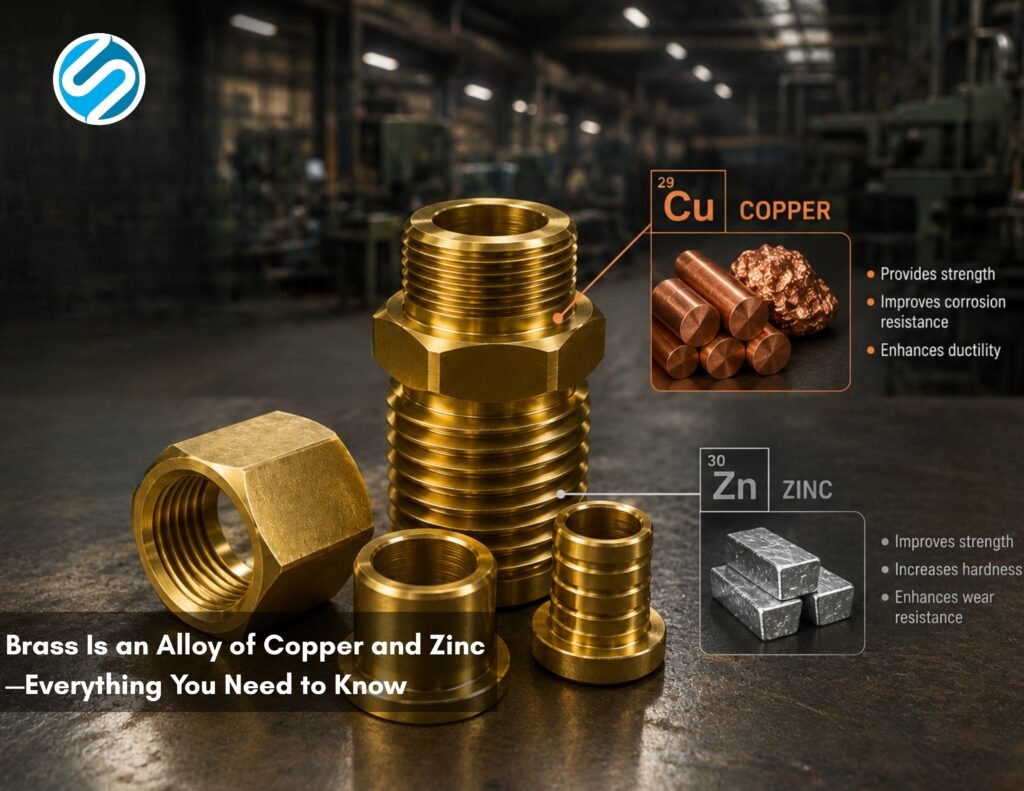
Copper and zinc — two reliable metals combined — and suddenly you have one of the most trusted materials in modern manufacturing. That is brass in a nutshell. Plumbing, electrical engineering, decorative hardware, artistic framework—brass is an alloy of these two metals that has quietly worked its way into almost every corner of industry. The strength, workability, corrosion resistance, and value it offers from a single material is genuinely hard to match. Before committing brass to any project, most engineers and buyers want to know what is brass an alloy of at its core—because that base composition shapes everything from material selection to long-term performance on the job. And it does not stop at industry either. Brass instruments—trumpets, trombones, French horns—owe their acoustic richness and structural flexibility to this exact same copper-zinc combination.
What Is Brass and What Is It Made Of?
Brass is an alloy of copper and zinc, with the elemental copper proportion being 60%-90% and the elemental zinc proportion being 10%-40% depending upon the grade classification. This concentration can also vary depending upon the formation: with more concentration of Copper, you get softer and more ductile brass, and with more concentration of Zinc, you get harder and more sturdy brass.
This explains why, what is brass an alloy of, is a term frequently used. Because brass is a combination of these metals, where Zinc is brittle and Copper is utterly soft and too expensive on its own. Even though alone, Zinc and Copper have these characteristics, and their combination leads to instances that are the contrary, where the resultant metal is strong, easily machinable, and has a high corrosion resistance.
Here are some facts about brass and its component percentages:
- standard yellow brass is made of about 67% copper and 33% zinc.
- red brass has 85% copper (has better resistance to corrosion).
- tin is added to naval brass to help give some performance for brass in marine environments.
For industries that need precision components, knowing the brass is an alloy of percentage necessary. Even the smallest adjustments in the percentages drastically change the brass’s performance in the presence of heat, pressure, and corrosion.
Physical Properties of Brass
Because of the physical characteristics of brass, it has some properties that stand out as unique compared to those of other metals.
Most metals demand extreme heat before they even begin to soften — brass is a different story. Its brass melting point sits between 900°C and 940°C, shifting slightly based on the zinc percentage in the mix. Pure copper needs 1085°C to liquefy, which makes it far more demanding on equipment and energy costs. That gap matters on the factory floor, and it is exactly why manufacturers prefer working with brass for casting and forging. A lower brass melting point means faster production cycles and reduced furnace costs—and when you understand what the brass melting point actually means for day-to-day operations, the choice becomes obvious.
Corrosion Resistance and Conductivity: The copper content in brass forms a natural protective oxide layer that resists rust and degradation in water-based environments. Brass won’t win any awards for electrical conductivity—but 28% of copper’s conductivity is more than enough to make it a reliable choice for terminals, switches, and connectors where pure copper would be overkill. Add that to its corrosion resistance, machinability, and mechanical strength, and you start to see why Customized Brass Parts remain the first choice across some of the most demanding industrial applications out there.
Common Types of Brass and Their Applications
Brass is an alloy of copper and zinc and varies in concentration of the components to cater to the industry requirements and specifications.
- Yellow Brass (C26000) — 70% Copper and 30% Zinc. These are good for, among other things, radiators, plumbing and other brass components of ammunition.
- Red Brass (C23000) — 85% Copper. These are preferred for tubing, valves, and components of Pumps.
- Free-Cutting Brass (C36000) — These are free brass and, as the name suggests, these are brass alloy containing lead for the best possible machinability. These are preferred for screws, bolts, and other useful wards that carry out function with precision.
- Naval Brass (C46400) — These brass are useful in the ship and Marine industry due to the composition of tin.
Brass is as useful as it gets—and that versatility comes down to one thing: brass is an alloy of percentage. The exact copper-to-zinc ratio determines how well it handles heat, pressure, and moisture across any industrial condition.
Why Brass Dominates Industrial Fittings
Brass is preferred in the construction of plumbing and fluid-carrying components and for good reason. Its affordable, as other metals, and has the ideal properties to resist corrosion, withstand pressure and be easily processed.
Brass Fitting Parts are sought out by procurement teams and are constructed to specific dimensional trade to avoid leaks, pressure loss, or total system failure. This Brass components carry the full range of plumbing, HVAC, pneumatic and hydraulic systems.
Brass is the best choice for fittings for a variety of reasons, including the following:
- Excellent thread-cutting that doesn’t crack or strip
- Naturally antimicrobial, important when used for potable water
- Compatible with differing pipe system materials such as copper, steel, and PEX pipe
- Longevity with very little upkeep
- Brass is easy to join with solder or braze
According to one of the top brass manufacturer in Jamnagar, we see a surging need for brass precision components outside traditional areas of construction to oil and gas, automotive, and renewable energy businesses.
Brass Instruments and Everyday Uses
Brass instruments is a common alloy that is known for its versatility. Because of specific physical properties that improve with the presence of more copper in the alloy, Brass instruments is used in musical instruments such as trumpets, trombones, French horns, and tubas. The telltale shiny metallic yellow finish of brass adds to the aesthetics of architectural fittings and other artifacts.
Frequently Asked Questions (FAQs)
Q1. Brass is an alloy of which two metals?
Brass is an alloy of copper (Cu) and zinc (Zn), typically in a ratio of 60–90% copper and 10–40% zinc depending on the application.
Q2. What is brass an alloy of in terms of percentage?
What is brass alloy of when exact ratios matter — the standard brass is an alloy of percentage is 67% copper and 33% zinc for yellow brass. Higher copper grades go up to 85% copper.
Q3. What is the melting point of brass?
The melting point of brass is between 900°C and 940°C (1652°F to 1724°F), varying slightly based on zinc content.
Conclusion
With the records Brass is an alloy of Copper and Zinc electrolytes for many years and many industries. Brass is a reliable alloy suitable for excellent manufacturing precision. Components of brass are reliable, high quality, and retain their properties due to the excellent corrosion resistance of brass. In modern manufacturing brass is a dedicated alloy of industrial components. Unsurprisingly, brass is the trusted alloy for many quality components.