
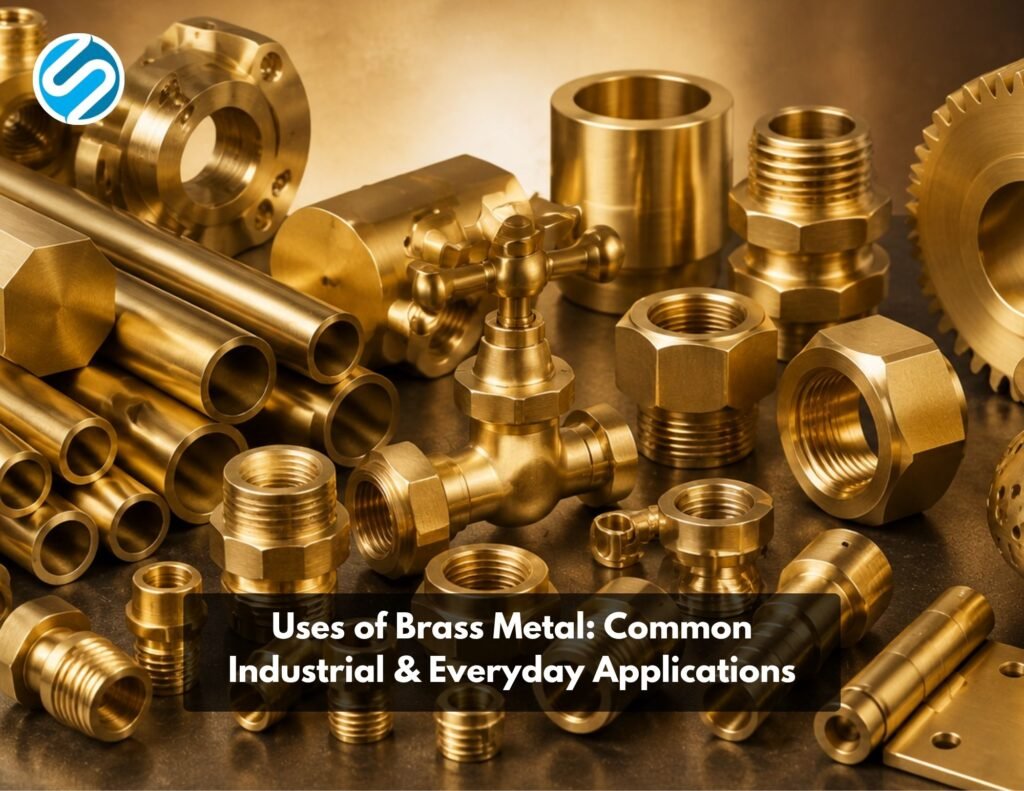
Brass has been appreciated for years because it looks good, feels solid, and is easy to work with. You’ll see it in everything from factory machinery to candle-holders on the living-room shelf. But why does this yellow-red metal keep turning up in so many places? The uses of brass metal span a wide range of industries due to its versatility and performance.
In this blog, we’ll explore the most common uses of brass, examine its material benefits, and understand where brass is used in everyday life and industrial sectors.
What Is Brass Used For?
Brass is used for electrical connectors, terminals, plumbing fittings, valves, fasteners, automotive parts, precision machined components, locks, door hardware, musical instruments, decorative products, and many other applications.
Some of the most common uses of brass include:
- Electrical terminals and connectors
- Plumbing fittings and valves
- Precision machined components
- Brass nuts, bolts, and fasteners
- Automotive components
- Locks and security hardware
- Architectural fittings
- Marine components
- Telecommunications components
- Musical instruments
- Furniture hardware
- Lighting fixtures
- Decorative products
- Kitchen and household items
- Industrial machinery components
The specific application depends on the brass grade, component design, operating environment, and required mechanical or electrical properties.
What Is Brass Metal?
Before diving into uses, lets clear up exactly What Is Brass Metal. Brass is a metal blend, mostly copper and zinc, with tiny bits of lead, tin, or other materials sometimes added to tweak performance. The amount of copper and zinc in each batch changes the alloys color, strength, and how well it resists rust, so makers can fine-tune it for each job.
Because of that mix, brass combines toughness, easy bendability, and solid rust-proofness. Those traits make it a favorite wherever parts must hold up, slide past each other, or look good at the same time.
To get a closer look at how brass is made and what it can do, check out our full guide on Brass Composition.
Why Is Brass Used in So Many Applications?
The large number of brass uses can be explained by the material’s balanced combination of physical, mechanical, and manufacturing properties.
Excellent Machinability
Brass can be cut, drilled, turned, threaded, and shaped efficiently. This makes it particularly suitable for manufacturing precision components with detailed geometries.
Corrosion Resistance
Many brass alloys provide good resistance to corrosion, making them suitable for plumbing, industrial fittings, hardware, and other applications where components may encounter moisture.
Electrical Conductivity
Because brass contains copper, it provides useful electrical conductivity. This is one reason it is widely used for terminals, connectors, pins, and other electrical components.
Strength and Durability
Brass provides a useful balance between strength and workability, allowing manufacturers to produce durable components without making machining unnecessarily difficult.
Attractive Appearance
Its naturally warm, gold-like appearance also makes brass popular for architectural hardware, furniture fittings, lighting fixtures, and decorative applications.
Industrial Uses of Brass metal
1. Electrical & Electronic Components
One of the most significant brass applications lies in the electrical and electronics industry. Brass is commonly used to manufacture terminals, connectors, pins, and switch components due to its excellent electrical conductivity and resistance to corrosion.
In settings where every tiny detail matters, brass shines when crafting small, precise parts. Its strength means the pieces stay together and keep working, even inside demanding machines. This is one of the most reliable uses of brass metal in modern manufacturing.
Take brass connectors in high-end equipment: they help everything from cars to computers run smoothly. To see why engineers trust them, check out this overview on brass connectors.
2. Plumbing and Sanitary Fittings
Where is brass used the most in household and infrastructure systems? Plumbing is a key area. Due to its corrosion resistance and ability to withstand high temperatures and water pressure, brass is a top choice for faucets, valves, hose connectors, pipe fittings, and taps.
Unlike iron, brass won’t grow a flaky coat of rust, and it stays flexible long after plastic cracks. These benefits add up to years of leak-free service in factories, hotels, hospitals, subway stations, and residences all around the world.
3. Precision Machined Components
In industrial settings, brass metal uses are strongly tied to its compatibility with machining processes like CNC and VMC. At Suraj Brass Industries, we specialize in manufacturing precision brass components that meet global quality standards.
That machining friendliness lets us make high-tolerance pieces for cars, planes, medical gear, and telecom devices.
Curious about the steps we take? Head over to the blog post How Is Brass Manufactured? to see how raw ingots become the parts you trust every day.
4. Automotive Components
The automotive industry represents another important area for industrial uses of brass. Vehicles require numerous small metal components that must provide dimensional accuracy, mechanical reliability, and resistance to demanding operating environments.
Depending on the vehicle system and component specification, brass can be used for electrical connectors, terminals, sensor-related parts, fittings, adapters, bushings, and precision-machined components.
5. Brass Fasteners
Brass is also used to manufacture many types of fastening components.
Common examples include:
- Brass screws
- Brass nuts
- Brass bolts
- Washers
- Threaded inserts
- Studs
- Anchoring components
Brass fasteners can be useful when corrosion resistance, electrical characteristics, appearance, or material compatibility are important considerations.
6. Telecommunications Applications
Telecommunication equipment often contains small connectors, pins, terminals, and other precision components.
Brass is useful in these applications because manufacturers can machine it into small and complex forms while retaining the electrical and mechanical properties required by the component specification.
7. Architectural and Construction Hardware
Brass has a long history of use in buildings because it combines functionality with an attractive finish.
It may be found in:
- Door handles
- Hinges
- Locks
- Knobs
- Architectural fittings
- Furniture hardware
- Decorative fixtures
Its appearance is particularly beneficial when the component remains visible after installation.
8. Marine and Specialized Engineering Applications
Certain brass alloys are also used for selected components in marine and specialized engineering environments.
Fittings, connectors, fasteners, and other machined components can be manufactured from suitable brass grades when their properties match the application’s operating conditions.
The correct brass alloy should always be selected according to environmental exposure and technical requirements rather than assuming every brass grade performs identically.
Common Brass Applications by Industry
| Industry | Examples of Brass Applications | Important Brass Property |
| Electrical | Terminals, pins, connectors | Conductivity |
| Plumbing | Valves, fittings, couplings | Corrosion resistance |
| Automotive | Connectors, fittings, precision parts | Strength and machinability |
| Manufacturing | CNC components, bushes, inserts | Machinability |
| Construction | Locks, handles, hinges | Durability and appearance |
| Telecommunications | Pins, terminals, connectors | Precision and conductivity |
| Furniture | Handles, fittings, decorative hardware | Appearance |
| Musical Instruments | Trumpets, horns and related instruments | Formability and acoustic suitability |
Everyday Applications of Brass Metal
The uses of brass in daily life are easy to overlook because many brass components are small or built into larger products. However, brass can be found throughout homes, offices, public buildings, musical equipment, furniture, and decorative products.
1. Home Décor and Hardware
Brass shines like gold, so designers love to use it around the house. You’ll see it in light fixtures, door knobs, curtain poles, furniture trim, and even wall art. Thanks to strength and that constant polish, these accents stay useful and good-looking for years.
These are aesthetic yet functional uses of brass that combine form and function seamlessly.
2. Musical Instruments
From trumpets and tubas to saxophones, brass applications extend into the world of music. Brass is favored for its ability to produce bright, resonant sounds and for its ease of shaping into complex instrument designs.
This one-of-a-kind acoustic trait slots brass into the heart of both classical symphonies and modern pop tracks.
3. Kitchenware and Utensils
Where is brass used in traditional kitchens? In parts of the world such as India, old plates, pots, storage jars, and even ritual bowls are still made from this metal. Though many cooks now grab stainless steel first, brass never lost its cultural and cleaning perks.
Its antibacterial properties make it a great material for water storage and dry goods containers—another practical use of brass metal.
What Is Brass Used to Make?
If you’re wondering what brass is used to make, the answer covers everything from tiny electrical pins to large architectural fixtures.
Manufacturers use brass to produce components such as connectors, terminals, inserts, fasteners, valves, fittings, bushes, pins, adapters, locks, handles, decorative hardware, and precision CNC parts.
This variety demonstrates why brass continues to be an important engineering material. Rather than serving one specific industry, it can be adapted to applications requiring different combinations of machinability, conductivity, corrosion resistance, strength, and appearance.
How to Select Brass for Different Applications
Not every brass alloy has identical properties. Choosing a suitable material requires understanding where and how the finished component will be used.
Important considerations include:
- Required mechanical strength
- Electrical conductivity
- Operating temperature
- Exposure to moisture or corrosive conditions
- Component dimensions
- Thread requirements
- Machining complexity
- Surface finish
- Industry-specific specifications
For precision components, manufacturers must consider both material properties and manufacturing tolerances to ensure that the finished component matches its intended application.
Why Brass Remains a Preferred Material
From a factory floor point of view, brass is a superstar material. Here’s why:
- Excellent machinability: Tools stay sharp longer, and you can run lathes at higher speeds.
- Corrosion resistance: Parts survive wind, rain, salt, and chemicals for many years.
- Recyclability: Melting scrap back into new stock uses far less energy than mining ore.
- Visual appeal: The warm, gold-like color works in factory floors and living rooms alike.
- High strength-to-weight ratio: Components are light but stand up to heavy loads.
These benefits account for the broad applications of brass metal uses in many industries and explain why engineers and designers have always favored it.
Conclusion
The broad range of uses of brass metal demonstrates why the alloy remains important across modern manufacturing and everyday products. Electrical connectors, plumbing fittings, automotive components, precision parts, fasteners, locks, architectural hardware, musical instruments, and decorative products are only some examples of where brass is used.
Its combination of machinability, corrosion resistance, conductivity, strength, and visual appeal enables manufacturers to produce everything from tiny precision components to larger functional hardware.
For industrial buyers, selecting the appropriate brass material and component specification is essential because requirements differ according to application, environment, dimensions, and performance expectations. Suraj Brass Industries manufactures precision brass components for a wide range of industrial applications and customer specifications.
Suraj Brass Industries delivers precision-engineered brass components designed to meet diverse industrial and manufacturing requirements. With a focus on quality and accuracy, the company serves businesses across a wide range of brass applications.
FAQs – Uses of Brass
1. What is brass most commonly used for?
Brass is commonly used for electrical connectors, terminals, plumbing fittings, valves, fasteners, locks, precision components, architectural hardware, musical instruments, and decorative products.
2. What are the main industrial uses of brass?
Industrial brass applications include electrical parts, CNC machined components, automotive parts, plumbing fittings, fasteners, telecommunications components, and engineering hardware.
3. What is brass used to make?
Brass is used to make connectors, pins, terminals, valves, fittings, screws, nuts, bolts, inserts, bushings, locks, handles, musical instruments, and decorative components.
4. Why is brass used for electrical components?
Brass provides useful electrical conductivity along with strength, corrosion resistance, and excellent machinability, making it suitable for many terminals and connectors.
5. What are common uses of brass in everyday life?
Brass can be found in door handles, locks, hinges, furniture hardware, lighting fixtures, musical instruments, household fittings, and decorative products.
6. What are the common uses of brass in daily life?
The uses of brass in daily life include door handles, locks, hinges, faucets, lighting fixtures, furniture hardware, musical instruments, decorative items, and household fittings. These common brass uses in daily life are supported by the metal’s durability, corrosion resistance, machinability, and attractive appearance.