
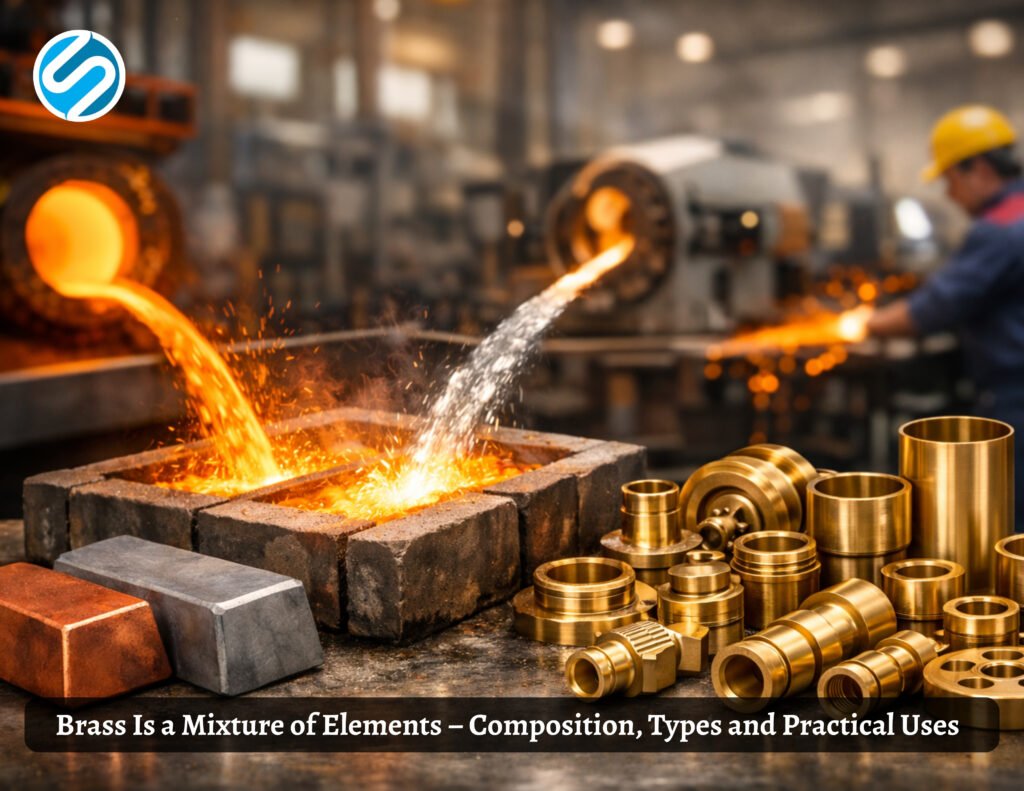
Introduction to Brass Material
Pure metals are rarely used in modern production methods when designing a new product as a result of the lack of appropriate strength, durability, and corrosion resistance. Instead, they are relying on alloys. Brass, for example, is a widely and easily used alloy. Brass is a mixture of the combination of copper and zinc, forming a composite material with a wide range of strength, workability, and reliability.
When learners and buyers see brass, they ask if it is a mixture or a pure element. Brass is also not a single metal; it is an amalgamation of several metals and is precisely engineered to bring forth the best attributes of each. This engineered versatility makes it a prime candidate for plumbing fittings, electrical connectors, components in hardware and parts that are precisely turned. The attractive gold-like color of the alloy also makes it an excellent choice for applications that are aesthetic in nature.
What Does It Mean That Brass Is a Mixture of Metals?
In the study of materials, a common question asks whether brass is a mixture or compound. Compounds are pure substances that contain a set ratio of the same molecules. However, alloys are a mixture of metals. This means that brass is considered an alloy. Because the brass structure is made of evenly distributed copper and zinc, brass is a homogeneous mixture.
The reason brass is a mixture of balanced properties comes from how each element contributes:
- Copper gives excellent thermal and electrical conductivity
- Zinc increases hardness and resistance to wear
- The metals combined improve the overall durability
- The alloy that makes brass resists corrosion when exposed to wet conditions
- Ratios can be adjusted for specific applications
This flexibility makes brass extremely useful across industries.
Brass Is Made Up Of Which Elements?
The brass is made up of two metals, copper and zinc. Manufacturers may introduce small quantities of other metals to improve certain performance characteristics. Because brass is made up of it, it can be modified and tailored for specific industrial applications and needs.
The small addition of other metals like lead, tin, and aluminum to copper and zinc increases brass’ resistance to corrosion, durability, and machinability. This makes it effective for use in electrical and mechanical devices.
The composition and formula of brass are important to understand.
To achieve specific desired properties, the composition of brass must be changed. The formula used to create brass cannot be defined like a traditional compound since brass is an alloy, meaning that instead of a specific compound, the formula of brass is expressed as an alloy of a specific composition, that is, a Cu-Zn alloy.
The composition of brass is about 60–70% copper and 30–40% zinc. Because of its Cu-Zn alloy composition, the variability of the ratio and formula of brass is flexible; brass is a mixture of varying ratios and the properties of brass are used to attend to specific needs in industries such as construction, plumbing, and electrical, etc.
For example, automotive connectors and fittings manufactured as Brass Auto Parts require strength, corrosion resistance, and machinability in a single material.
Types of Brass Based on Composition
Different copper-zinc ratios produce different grades of brass, and the composition of brass directly affects mechanical properties and durability.
- Alpha brass—softer and corrosion resistant
- Alpha-beta brass—stronger structure
- Leaded brass—easy machining for precision parts
- Cartridge brass—used in connectors and casings
- Marine brass—resistant to seawater
Each type shows how brass is a mixture of engineered properties suited for specialized applications, including industrial assemblies such as Brass Components.
Why Brass Is a Homogeneous Mixture
During production, both zinc and copper join together smoothly in an even mixture. This causes brass is a homogeneous mixture instead of a layered metal. Because of uniform distribution, the performance of the metal remains uniform. This structure closely relates to the question of brass mixture because of the homogeneity. Each part of the metal experiences the same effect when stressed and when a load is applied.
When consistent response is critical for the fittings, connectors, and machined parts, uniform composition is of extreme importance.
Practical Uses of Brass in Industries
Because brass is a mixture of strength and conductivity, it serves a wide range of industries:
- Automotive components
- Precision machined parts
- Plumbing valves and fittings
- Electrical terminals and connector pins
- Decorative and architectural hardware
Brass is made up of in both electrical and mechanical environments because it has both the conduction of copper and the strength of zinc. Manufacturers producing High-Precision Brass Products rely on brass for its consistent machining and long service life.
Brass vs Pure Metals—Why Industry Prefers Brass
Pure copper is soft and expensive, while zinc alone lacks durability. However, brass is a mixture of both metals, producing a balanced material. Brass is easier to work with, lasts longer, and resists corrosion better than pure metals.
These advantages make brass a practical engineering solution, especially where durability and cost efficiency are required, which is why many industries confirm that is brass mixture a reliable material and understand is brass mixture suitable for long-term applications.
Frequently Asked Questions
Is it a brass mixture or compound?
The question brass is a mixture or compound common in metallurgy. Brass is an alloy, meaning a homogeneous mixture of metals rather than a chemical compound.
What is the formula of brass?
The formula that is generally used for brass is referred to as Cu-Zn alloy, as it tends to have a varying composition.
Why is brass considered homogeneous?
Brass is a homogeneous mixture because the uniform distribution of metals throughout the mixture gives it consistent properties.
Conclusion
Brass is a mixture of copper and zinc and is made to have a combination of strength, conductance, and resistance to corroding. Its adjustable and adaptable formula of brass and composition of brass allows manufacturers to tailor it for different industries. This brass is a mixture of the most common elements used in modern manufacturing and engineering.