
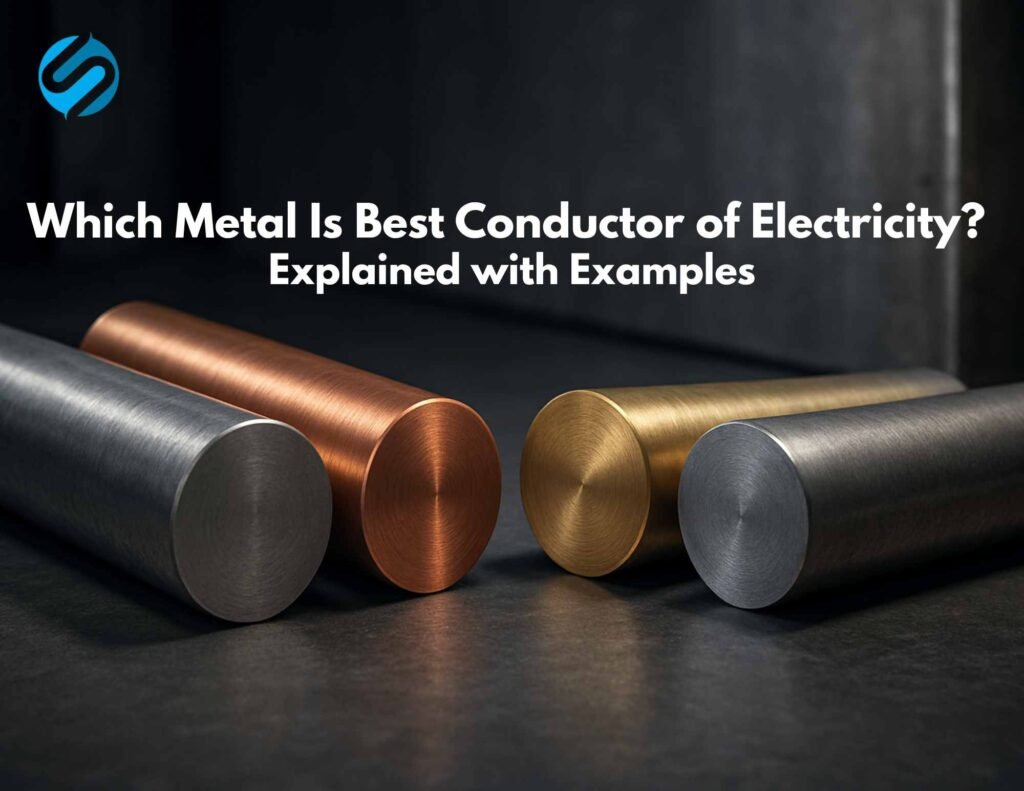
Today, nearly everything we use, from tiny phone chips to huge factory motors, runs on electricity. Yet when we look at the wires and parts inside those machines, some metals move electric current way better than others, and the difference between a good choice and a poor one can decide whether a product lasts for years. This article reveals which metal is best conductor of electricity, explains conductive metal basics, and shares real examples like the brass components made by Suraj Brass Industries for electrical use.
Buyers and engineers who search which metal is the best conductor of electricity are usually trying to solve one practical problem: how to move current with the least loss, at a cost and weight a real project can afford. Suraj Brass Industries builds a wide catalogue of Brass Forging Parts, and forged brass gives manufacturers a dependable conductor that also holds up to torque, vibration, and repeated assembly.
What Is a Conductive Metal?
A conductive metal is one that has low resistance and lets electrons flow through it easily, thanks to an atomic structure that makes it easy for electrons to move around, while insulators stop or slow that flow a lot. Engineers rarely stop at “is it a conductive metal or not” — they weigh resistivity, purity, temperature behavior, and mechanical durability together, as shown below, before deciding which metal is the best conductor of electricity for a specific part.
- Resistivity/conductivity: how easily electrons can move; the more conductive something is, the less resistive it is
- Purity: impurities, alloying, and microstructure faults all raise resistance
- Temperature: as heat rises, metals vibrate more, causing more collisions and reduced conductivity
- Mechanical and environmental properties: a metal also needs to stand up to everyday stress and rust
Most people never ask which is the best conductor of electricity out loud, but they rely on the answer every day, inside the plug in the wall and the fittings behind a light fixture. Suraj Brass Industries turns that conductivity science into finished Brass Decorative Parts that homeowners and contractors trust for both appearance and reliable current flow, the same way these five everyday categories all depend on a strong conductive metal at their core:
- Electrical connectors and terminal blocks, which need a stable, low-resistance contact surface
- Switchgear and busbars, where sustained current flow at scale is the whole design goal
- Decorative and architectural fittings, where brass supplies conductivity and corrosion resistance together
- Motor windings and transformer coils, which depend on copper’s balance of conductivity and formability
- Overhead and underground power cables, which favor aluminum or copper depending on span and load
Silver vs Copper vs Aluminum: Which Metal Conducts Electricity Best?
Ranking a conductor on a lab bench is easy; ranking it for a real product is not. Engineers routinely ask which metal conduct electricity best for a specific job, and the honest answer changes depending on what that job demands. Buyers researching which metal is the best conductor of electricity for a new product often start here, since a lab test measures pure conductivity under controlled conditions, while a real installation also has to survive vibration, moisture, and years of continuous load.
Gold rarely wins a straight conductivity contest, yet manufacturers still specify it for contacts and connector plating because it resists corrosion for decades without degrading the electrical path — a good conductor of electricity metal chosen for reliability, not just raw performance. Aluminum answers a third question entirely — which metal wins on conductivity per kilogram — and that is exactly why national power grids are strung with aluminum instead of copper or silver over long distances.
Export-Grade Hardware and the Conductivity Trade-Off
Silver tops every conductivity chart, which is why precision-electronics manufacturers still ask which metal is the best conductor of electricity and get the same answer every time. Copper answers the practical question instead, combining strong conductivity with a price and durability that scales to millions of units. Suraj Brass Industries builds its Export Brass Hardware around this exact trade-off between conductivity, cost, and long-term reliability.
Reading the Conductivity Table Correctly
Some metals are clearly among the best conductors of electricity based on testing at around 20°C. The table below shows how the top four candidates stack up once cost, weight, and durability enter the picture alongside raw performance, which matters far more than the chart alone once a design has to survive real conditions.
|
Metal |
Conductivity |
Strengths |
Limitations |
|
Silver |
~6.30×10⁷ S/m |
Highest conductivity; excellent in precision electronics |
Very expensive; tarnishes; softer mechanically |
|
Copper |
~5.96×10⁷ S/m |
Excellent balance of performance and cost |
Oxidation; heavier than aluminum |
|
Gold |
~4.10×10⁷ S/m |
Corrosion resistant; ideal for plating contacts |
Extremely expensive; rarely used in bulk |
|
Aluminum |
~3.50×10⁷ S/m |
Lightweight, cheaper; widely used in power lines |
Lower conductivity per volume; expands more |
|
Others |
Substantially lower |
Often used for strength or cost reasons |
Conductors that don’t work as well |
The comparison above is not just a ranking by magnitude. A component that only needs to carry a small current over a short distance can use almost any metal on this list, while a busbar, connector, or export cable will fail early if corrosion resistance and mechanical strength are ignored in favor of the highest raw conductivity number alone.
Silver is the best metal for conducting electricity according to science, while people still think copper is the best in real life since it is cheap, lasts a long time, and is easy to source at scale. Buyers who need documented, tested conductivity data for customs or quality audits often request pre-shipment reports, and Suraj Brass Industries supplies Reliable Brass Components with verified specs so procurement teams can confirm performance before an order ships.
Total Cost of Ownership: Why Conductivity Alone Doesn’t Decide
A conductivity chart only tells part of the story, because the real cost of a part includes raw material price, machining time, scrap rate, and how long the finished component lasts in service before it needs replacing. A cheaper metal that corrodes in two years and needs replacing costs a buyer far more over time than a slightly pricier metal that lasts a decade without failing.
This is why procurement teams increasingly ask suppliers for total cost of ownership figures rather than a single conductivity number pulled from a textbook. Suraj Brass Industries builds this thinking into every quote, weighing raw material cost against expected service life, maintenance needs, and the failure risk of using the wrong conductive metal in the wrong environment — because which metal is the best conductor of electricity on paper is not always the metal that survives five years of real-world service.
Why Not Always Use the Highest Conductor?
Silver is the highest conductor of electricity, but it isn’t the one the industry picks every time, for a handful of practical reasons that surface the moment a lab sample becomes a real production part shipped to a paying customer on a tight budget, a fixed delivery schedule, and a long expected service life in the field:
- Cost: silver is fine in the lab, but the price tag makes it a no-go for big projects
- Durability and strength: softer metals can bend or deform under load
- Corrosion: some metals rust or change color as they corrode over time
- Weight: aluminum is light, which suits anything that needs to cover long distances
Role of Alloys and Brass in Real Components
When answering which metal is best conductor of electricity, alloys complicate the picture. When different conductors metals are mixed together, the new alloy usually conducts electricity worse than the separate metals did on their own. Copper and zinc create brass, and even though brass conducts less well than pure copper, manufacturers use it widely for its strength, workability, and corrosion resistance in the field.
Suraj Brass Industries creates a lot of brass electrical parts and stays careful to make sure every part is both sturdy and conductive, since a fitting that loses conductivity or shape under stress fails the customer either way. Read our in-depth article on the thermal conductivity of brass to discover more about how brass transfers heat and electricity together in one component.
Other common alloys follow the same trade-off pattern. Bronze, an alloy of copper and tin, conducts less efficiently than pure copper but resists wear and corrosion better in marine and industrial settings. Nickel-copper alloys sacrifice even more conductivity for exceptional corrosion resistance in harsh chemical environments, and comparing these conductors metals side by side is exactly why alloy selection always comes down to matching the metal to the operating conditions rather than picking whichever one tops a conductivity chart.
Common Myths About Conductive Metals
A common myth is that any metal will work as a conductor as long as it is not an insulator, when in reality the difference between a good conductive metal and a mediocre one can be a factor of ten or more in resistance. Another myth is that thicker wire always fixes a conductivity problem, when using the right metal is usually cheaper and more effective than oversizing a poor conductor.
A third myth is that gold is only used for looks. In reality, gold plating is chosen specifically because it is a stable, corrosion-resistant conductor for connector pins that get plugged and unplugged thousands of times over a product’s working life, not for appearance in most industrial and electronic applications. Even a very thin gold layer over a base conductor is enough to deliver this benefit at a fraction of the cost of a solid gold part.
Export-Grade Comparison: Copper vs Brass
A quick side-by-side of why international buyers choose each metal for export-grade electrical hardware, once machinability and shipping conditions matter as much as the conductivity spec sheet itself, is easiest to see laid out directly against one another before placing a bulk order or signing off on a new long-term supplier relationship:
|
Requirement |
Pure Copper |
Brass (Copper-Zinc) |
|
Electrical conductivity |
Very high |
Moderate to good |
|
Machinability for precision parts |
Moderate |
Excellent |
|
Corrosion resistance in shipping/humidity |
Moderate |
High |
|
Typical use |
Windings, cabling |
Connectors, terminals, fittings |
Five reasons Suraj Brass Industries keeps brass at the center of its product line for electrical hardware sold into export markets, beyond the raw conductivity number that shows up on a lab data sheet or spec comparison sent to a new customer during initial sourcing conversations:
- Reliable current flow for terminals, sockets, and connector bodies
- Corrosion resistance that survives long export shipments and humid climates
- Precision machinability for tight-tolerance electrical fittings
- A favorable strength-to-weight ratio compared with pure copper hardware
- Cost stability that keeps large export orders predictable quarter to quarter
Industries That Rely Most on Conductive Metals
A handful of industries drive most of the global demand for high-performance conductors metals, and each one weighs the silver-copper-aluminum-brass trade-off a little differently depending on scale, budget, and operating environment, which is exactly why no single metal wins across every sector at once:
- Power generation and grid infrastructure, which run almost entirely on copper and aluminum
- Consumer electronics, where copper and gold-plated contacts dominate small precision parts
- Automotive and EV manufacturing, where copper demand has grown sharply with electric drivetrains
- Construction and architectural hardware, where brass balances conductivity with corrosion resistance and finish
- Aerospace and defense, where weight-to-conductivity ratio often outweighs raw performance alone
How to Choose the Right Conductive Metal for Your Application
Start by asking which metal conduct electricity best for your exact constraint, because “best” changes with the job at hand. Copper is the right default for budget-sensitive, high-volume runs, while aluminum earns its place in weight-sensitive installations even though it trails copper on raw conductivity per unit volume. Brass and gold-plated contacts outperform bare copper wherever corrosion from humidity or export shipping is the real concern.
Suppliers who understand this trade-off can save a buyer real money before the first unit ever ships, simply by recommending brass or aluminum instead of over-specifying copper or silver for a job that does not need that level of raw conductivity in the first place. Suraj Brass Industries builds this consultative approach into every project quote rather than treating every order as an identical conductivity spec sheet.
So, Which Metal Is Best Conductor of Electricity?
The short answer is silver in the lab and copper on the factory floor, and neither answer changes once export volumes, customs handling, and years of field service enter the picture for a real buyer. So, which metal is the best conductor of electricity in practice? International buyers who search which metal conduct electricity best for connector-grade hardware usually land on the same shortlist: copper for raw conductivity, brass for durability and machinability, and aluminum where weight is the deciding factor.
Put plainly, silver remains the best conductor in absolute laboratory terms, copper is the best conductor of electricity for practical manufacturing, aluminum is the best conductor of electricity for weight-sensitive transmission, and brass is the conductive metal of choice whenever a part must survive handling, corrosion, and years of everyday service.
Conclusion
When considering which metal is best conductor of electricity, consider silver first; however, it will not necessarily work as the best conductor of electricity for practical day-to-day use, so copper remains the overall best practical conductor of electricity for most buyers. Suraj Brass Industries is known for making high-quality brass electrical parts that offer great conductivity, corrosion resistance, strength, and durability for electrical connections and industrial use.
For buyers who need one takeaway: match the metal to the job rather than chasing the highest number on a conductivity chart, since silver wins the lab test, copper wins the factory floor, aluminum wins on weight, and brass wins wherever a fitting must keep conducting electricity reliably for years without failing under real operating conditions and repeated handling.
Frequently Asked Questions
Silver has the highest conductivity, but copper is used far more often since it costs less.
Yes, reasonably well — less than pure copper, but strong enough for durable connectors.
Cost makes silver impractical at scale, so grids use aluminum and copper instead.