
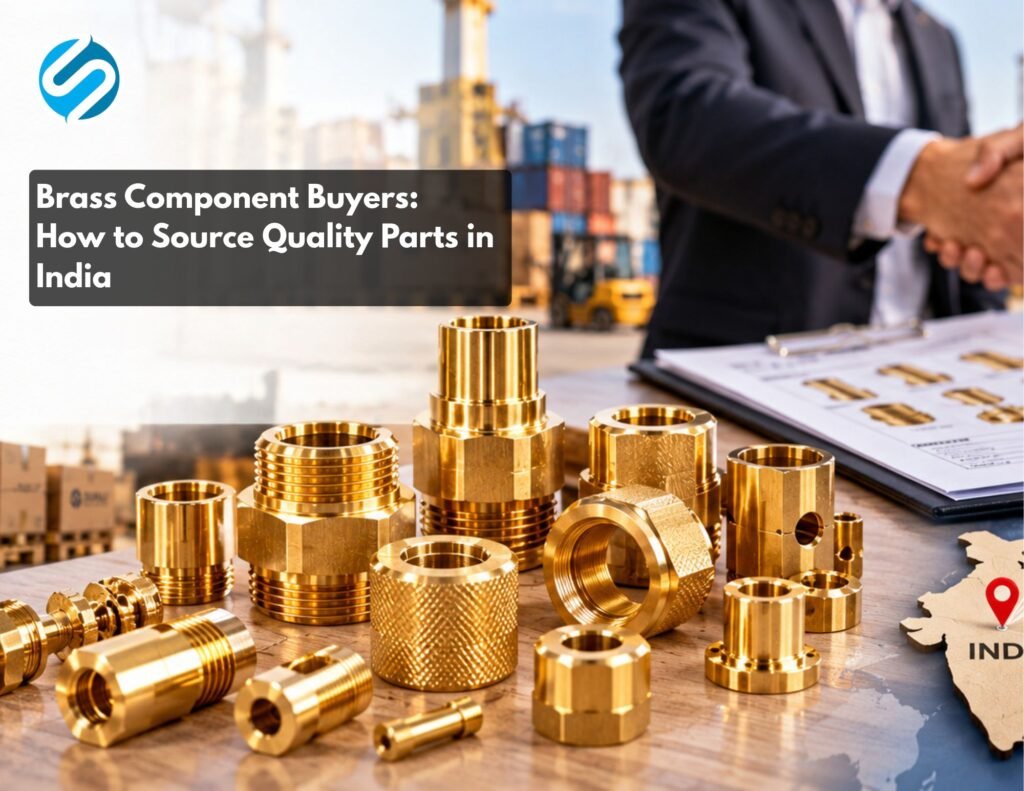
A pallet of brass fittings lands at your warehouse. The parts look fine. Then your QC team runs a thread gauge, and one in every five fails. Plenty of brass component buyers have a story like this, and it usually starts the same way: a supplier picked on price, no sample run, and a drawing that said too little.
India, and Jamnagar in particular, makes a big share of the world’s brass parts. Finding a supplier there takes ten minutes. Finding one you can trust with a 20,000-piece order takes more work. This guide covers what to check, what to ask and how to place your first order with fewer surprises. To see the kind of parts on offer, take a look at our brass components range.
Why Brass Component Buyers Choose India
Jamnagar has been machining brass for decades. Raw material traders, forging shops, CNC turning units, platers and packers all sit within a few kilometres of each other. That short supply chain keeps costs down and lead times sensible.
Price is what gets people interested, but range is what keeps them. One good supplier can make fittings, inserts, electrical terminals and custom turned parts, so you fill a single container instead of managing four vendors. That’s why a lot of brass component buyers keep one Indian manufacturer as their main source and use a second one only as backup.
A Practical Buyer Guide for Brass Components
Use this buyer guide for brass components as a working checklist that you run before every new supplier, not just once.
Start With a Drawing That Leaves No Guesswork
“Half-inch brass fitting” isn’t a specification. “CW614N, 1/2″ BSP male thread, nickel plated, ±0.05 mm on the hex” is. Put the material grade, thread standard, tolerance, surface finish and packing method on the drawing. Every detail you add now saves an argument later.
Pick the Right Brass Grade
The grade decides how the part machines, how it handles water and what it costs. Here’s a quick reference:
| Brass Grade | Standard / Type | Typical Use |
| C36000 | US free-cutting brass | Turned parts, fittings, inserts |
| CW614N | EU free-machining brass | CNC turned and precision parts |
| CW617N | EU forging brass | Hot-forged valves and fittings |
| DZR brass (CW602N) | Dezincification resistant | Plumbing in aggressive water |
| Lead-free brass | Low-lead alloys | Drinking water parts, especially for the USA |
C36000 and CW614N are close equivalents, so a supplier who knows both can usually work to either drawing.
Run These Checks Before You Shortlist
- Ask for a valid ISO 9001 certificate and check who issued it
- Find out whether CNC turning and forging happen in-house or get outsourced
- Confirm that threads are checked with gauges and that every lot gets a dimensional check
- Request material test certificates with each shipment
- Order a sample or first-article batch before full production
- Get a written lead time and one named contact for your account
If a supplier hesitates on any of these, you have your answer. A buyer guide for brass components only works if you walk away from the suppliers who fail it. You can see how we handle each stage in our quality assurance process.
Brass Components for International Buyers: Export Basics
Getting the part right is half the job. Getting it to your door at the price you expected is the other half.
Most brass components for international buyers ship by sea, either in a full container or as LCL cargo for smaller orders. Brass fittings usually fall under HS code 7412.20. Your supplier should prepare the commercial invoice, packing list, certificate of origin and bill of lading.
Incoterms matter more than most first-time importers expect. A FOB Mundra quote and a CIF Houston quote aren’t the same price, even if the numbers look close. So before you compare offers on brass components for international buyers, convert every quote to the same Incoterm. Buying patterns also change by country. Canadian importers, for example, order a lot of plumbing fixtures and hardware. Our guide on Brass Products Export India to Canada shows how that works.
What Brass Component Buyers in USA Should Check
The US market has a few rules of its own, and threads come first. Most American drawings call for NPT, NPTF, UNC or UNF, so confirm your supplier has the right gauges before a single part gets cut.
Then there’s lead. Brass component buyers in USA sourcing parts that touch drinking water need lead-free brass. Under federal law, wetted surfaces can’t go above a weighted average of 0.25% lead. Many distributors also ask for NSF/ANSI 61 or 372 certification on the finished product.
Duties are the last piece. US tariffs on Indian goods have changed more than once recently, so check the current rate for your HS code before you lock in a landed cost. Many brass component buyers in USA also ask for RoHS declarations on electrical parts, and a serious exporter will provide these without any fuss.
Tips for Bulk Buyers of Brass Components
Volume changes the conversation. Bulk buyers of brass components can usually get a better unit price once orders cross a few thousand pieces, because machine setup and tooling costs get spread across more parts.
Here’s an example. A distributor needs 50,000 brass inserts a year. Instead of one huge order, they place a blanket purchase order and take the parts in four scheduled releases. The supplier can plan raw material better, the buyer holds less stock, and the price stays fixed for the year.
Keep an eye on the metal price, though. Brass tracks copper, and copper prices move. For bulk buyers of brass components, a clear price-validity period or a copper-linked pricing clause avoids awkward renegotiations halfway through a contract.
Large orders also tend to serve more than one industry. If you’re curious where these parts end up, our piece on Industrial Applications shows how precision brass parts are used in plumbing, electrical, automotive and medical work.
Final Thoughts
Good sourcing comes down to a clear drawing, the right grade, a proper sample run and honest paperwork. If you skip any of these, the savings from a cheap quote disappear fast. If you do them well, India becomes one of the most dependable sources brass component buyers can have.
Suraj Brass Industries has worked with brass component buyers across the USA, UK and Europe for over 15 years, from an ISO 9001:2015 certified plant in Jamnagar. Send us your drawing and you’ll have a quote within 24 hours.
Frequently Asked Questions
Q1. What is the minimum order quantity for brass parts from India?
It depends on the part and the material. Simple turned parts can start at a few hundred pieces. Forged parts need bigger runs to cover the die cost. Most suppliers will run a small sample batch first.
Q2. How long does shipping from India take?
Production usually takes a few weeks, depending on how complex the part is. Sea freight to the US then adds roughly three to six weeks, depending on the destination port.
Q3. Which brass grade is best for CNC turned parts?
Free-cutting grades like C36000 or CW614N. They machine cleanly and hold tight tolerances. For drinking water parts, use a lead-free or DZR grade instead.
Q4. Can Indian suppliers make parts to my own drawing?
Yes, most of the work out of Jamnagar is custom. Send a drawing, a CAD file or a physical sample, and you should get a sample batch to approve before mass production starts.
Q5. How do I check quality before placing a full order?
Ask for a first-article batch with a dimensional report and a material certificate. Check the threads with your own gauges. For large orders, hire a third-party inspector before the shipment leaves India.