
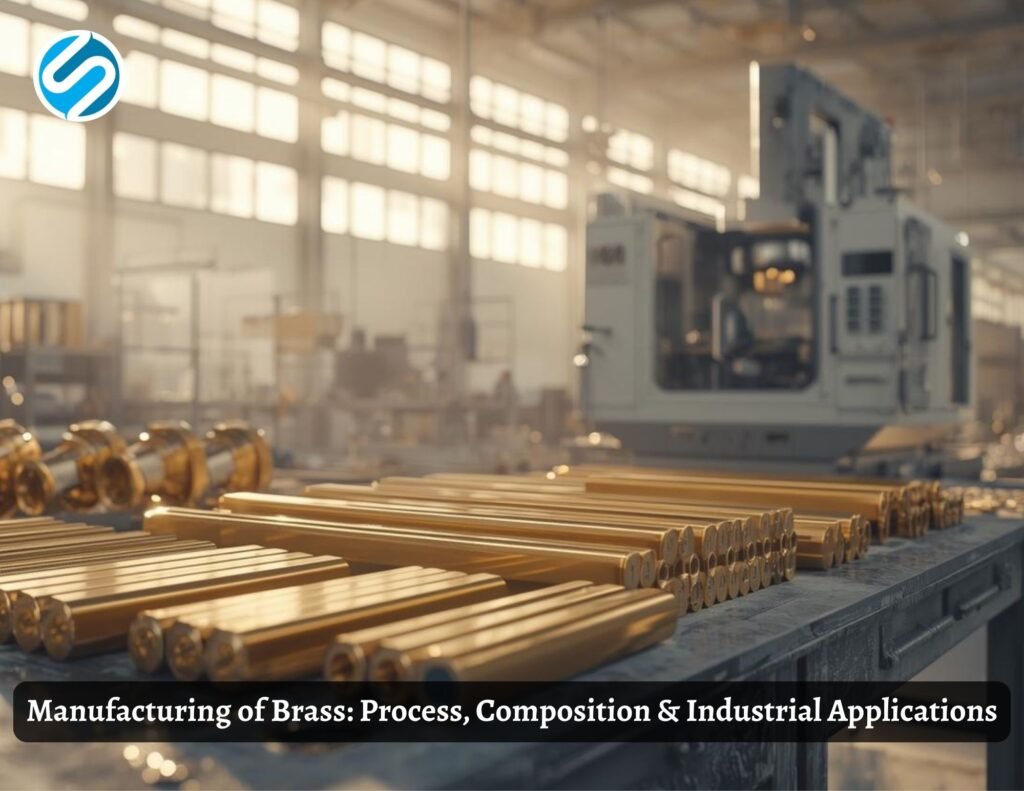
Brass is one of the most flexible and commonly utilized metal alloys in the current industry. Manufacturing of brass is essential in electrical, plumbing, automotive, construction and marine engineering. Its corrosion resistance, durability and excellent machinability make brass the alloy of choice for many high-performance components. There is a steady increase in the demand for brass manufacturing, especially in the rapidly developing industrial economies.
This article gives a detailed overview of the complete manufacturing of brass, its composition, the formation of the alloy, and its principal industrial uses.
Understanding Brass Composition
Brass is mainly an alloy of copper and zinc. The amount of zinc added to copper determines the mechanical attributes of the end product. More zinc means more strength and hardness, while more copper means a better corrosion resistance and conductivity.
How is brass formed? The answer is controlled alloying. Copper and zinc are melted at specific temperatures to produce a uniform alloy with improved characteristics. The composition can vary depending on the application at hand, whether it is for precision electrical terminals or heavy-duty plumbing fittings.
To guarantee uniform quality and consistency, brass begins with the highest quality raw brass materials available, preserving a strong internal structure.
How Is Brass Formed? Step-by-Step Process
To understand how is brass formed,, it is essential to understand the process of making the components and the sequential steps to make the alloy.
1. Raw Material Selection
This process starts with the selection of refined copper and zinc. The manufacturers of brass set quality standards to cut down on the number of contaminants.
2. Melting and Alloying
The copper in the furnace is turned into a liquid and zinc is added in measured amounts to the copper. This is the process where the brass becomes a stable alloy. During this process, the zinc should not be allowed to evaporate.
3. Casting
When the alloy is mixed evenly, the brass is into molds and allowed to form billets, rods, or ingots. This stage is especially important in the manufacturing process of brass.
4. Cooling and Solidification
The material is allowed to cool to a reasonable temperature before it is removed from the molds so that the structure does not lose its integrity.
The raw material’s brass formation process is essential in enabling various industries to identify the correct grade for specific functions.
Detailed Manufacturing Process of Brass
The steps of alloy formation are only part of the brass manufacturing process. There are several processes involved to change the raw brass into a completed product.
Extrusion and Rolling
Billets are heated and then sent to extrusion machines to construct rods, tubes, and profiles. Sheets and strips are made in rolling mills.
Machining and Shaping
Manufacturing of modern brass components employs highly advanced CNC machining for maximum accuracy. Brass parts manufacturing for industries is often customized for specific needs.
Surface Finishing
Aesthetics and corrosion resistance are enhanced through additional processes, including polishing, plating, and coating.
The complete cycle illustrates the industrial-scale manufacturing of brass that is achieved and the quality and accuracy in dimensions that are ensured.
Brass Manufacturing in India: Industry Growth
Brass manufacturing in India has made considerable progress, emerging as the foremost exporter of the brass components in Europe, Middle East and North America. India has a large skilled workforce, sophisticated machining, and affordable labor.
Growth of the infrastructure and electrical industries has directly increased the demand for brass manufacturing in India, and thus the export potential. Many well-known brass manufacturers have their factories certified by ISO, which helps them to meet global quality standards. India has a dense industrial cluster model, and focusing on exports will allow brass manufacturing in India to grow rapidly in the international as well as the local market.
Brass Manufacturing in Jamnagar – India’s Brass Hub
Brass manufacturing in Jamnagar has made India’s Brass City a well-deserved title. There are thousands of Jamnagar small and large scale businesses manufacturing various types of precision components.
Brass manufacturing in Jamnagar businesses encompass alloy manufacturing, machining, finishing, and exporting. Their supply chain is so robust, and so many top brass manufacturers operate out of the area.
Jamnagar brass manufacturers, with years of experience and a high level of technical ability, are sought after by businesses needing dependable suppliers.
The strength of brass manufacturing in jamnagar lies in its specialization in electrical, plumbing, automotive, and customized industrial parts.
Role of Brass Manufacturers in Industrial Applications
Brass manufacturers are industry specialists for a variety of precision components of varying complexity. The brass items used in these applications provide the desired level of performance and durability.
Industrial applications of the manufacturing of brass include:
- Electronic and electrical terminals
- Plumbing and valve fittings
- Automotive connections
- Building construction hardware
- Components for the marine industry
Many industries source ready-made brass components for large-scale applications.
For further information on the areas of application, you may consult this source on Brass Solutions for Industrial and Commercial Use.
Why the Manufacturing of Brass Is Preferred Across Industries
The growing importance of the manufacturing of brass is due to its unique advantages:
- Excellent corrosion resistant
- High thermal and electrical conductivity
- Strong machinability
- Long service life
- Recyclability and sustainability
Brass manufacturing is more centered on precision engineering and fully automated production lines that comply with accepted colas standard.
With expanding infrastructure and industrial demand, the future of manufacturing of brass looks promising, particularly in regions like India.
Conclusion
The manufacturing of brass is a highly structured industrial process that includes metallurgy, drilling, and quality control to make parts that will last. Industries need skilled workers and high-tech facilities to do everything from knowing how brass is made to mastering the whole process of making brass.
Because of its brass manufacturing in India, especially in Jamnagar, the country is one of the biggest exporters of high-quality brass goods to many different businesses. In the construction, electrical, and auto businesses, the need for high-quality brass products is rising. Customers need high-quality brass goods, which is why trustworthy brass makers give their customers high-quality brass goods.