
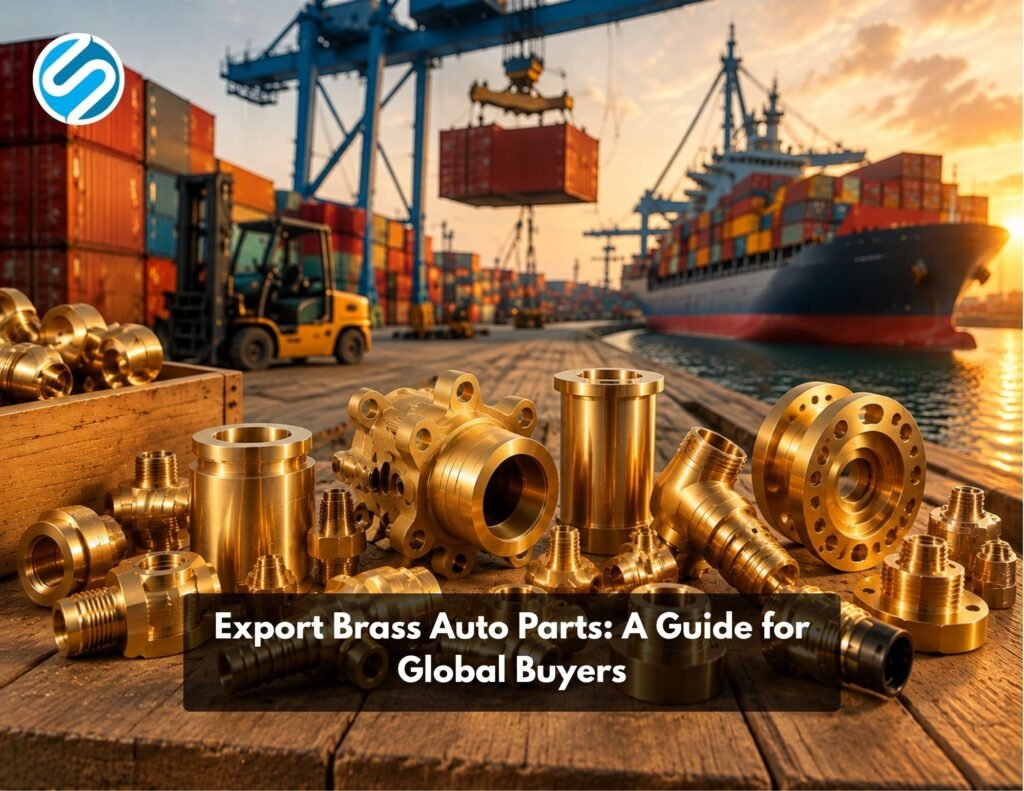
India has become one of the more reliable places for companies looking to export brass auto parts, and the reasons come down to more than just price. Brass has long been the preferred metal for fittings, connectors, and small automotive components because it machines well, resists corrosion, and holds tight tolerances without much fuss. If you’re new to sourcing from India, this guide walks through what actually happens between placing an order and getting it through customs.
Jamnagar, Gujarat, sits at the center of this industry. Manufacturers here have spent decades refining casting, turning, and forging processes for automotive-grade brass, mostly through trial and error and years of repeat orders from the same export markets. Buyers who source brass auto parts from established Jamnagar manufacturers tend to run into fewer surprises during production and shipping, which matters most once a shipment is already at sea.
Why India Is the Right Source to Export Brass Auto Parts
A few reasons keep bringing global buyers back to Indian suppliers:
- Competitive pricing without cutting corners on raw material grade
- Decades of hands-on experience in brass turning, forging, and stamping
- ISO-certified quality systems built around international automotive standards
- Flexibility to handle both bulk catalog orders and custom-drawing parts
- Established shipping routes to the USA, UK, Europe, and Australia
- Skilled labor concentrated in manufacturing clusters like Jamnagar
- Tolerance control down to 0.02mm on precision parts
Before placing an order, it helps to look through a brass components manufacturer’s catalog and see what’s already tooled versus what would need a new setup.
How to Export Brass Auto Parts from India: A Step-by-Step Overview
Most buyers asking how to export brass auto parts want to know where delays actually happen. The process itself isn’t complicated, but skipping a step early tends to cause problems later, usually around documentation.
1. Requirement and Drawing Finalization
The buyer sends technical drawings, tolerances, and finish requirements. Whatever gets locked in here shapes everything that follows, so it’s worth double-checking before production starts.
2. Supplier and Material Selection
The manufacturer confirms brass grade — free-cutting, leaded, or lead-free — based on what the destination country allows, then locks in the machining process.
3. Production and Quality Checks
Once tooling’s ready, parts move through turning, forging, or stamping depending on the design. Every batch gets checked for dimensions before it goes anywhere near packing, and finishing happens last, after the parts have already passed inspection.
4. Export Documentation
This is the part people underestimate. Commercial invoice, packing list, certificate of origin, HSN code — one mismatch between these and customs will flag the shipment, and that’s usually a delay nobody accounted for.
5. Shipping and Logistics
Sea freight covers most bulk orders. Air freight comes into play when a buyer needs a smaller batch fast.
When suppliers get asked how to export brass auto parts without hold-ups at customs, the honest answer almost always traces back to step four. Get the paperwork right, and the rest tends to move on schedule.
Choosing a Reliable Brass Automotive Components Exporter
Plenty of suppliers list automotive parts on their websites without actually being equipped to produce them at scale. A genuine brass automotive components exporter should be able to show ISO 9001:2015 certification, a documented QA process, and a track record of shipping to markets with strict compliance rules, particularly the EU and North America.
A few things worth checking before signing off on a supplier:
- Ask for third-party test reports on sample batches
- Confirm the factory actually manufactures in-house rather than routing work to unverified job shops
- Compare their quoted lead time against your own production schedule, not just the number they give you
- Ask for references from existing automotive-sector clients
This is where working with an established brass automotive components exporter tends to show its value — fewer rejected batches, fewer missed shipping windows, and far less back-and-forth over small defects.
Understanding the Export Procedure for Brass Components
The export procedure for brass components in India runs through the standard Foreign Trade Policy framework, though automotive parts sometimes need extra certification depending on the destination country’s rules — RoHS compliance for the EU is a common example.
Getting this step wrong doesn’t just slow things down. It can mean penalties or cargo held at the destination port for weeks. Buyers should confirm directly with their supplier that the export procedure for brass components has actually been completed before goods leave the factory, not after the container’s already booked.
Suppliers who regularly handle customized brass parts tend to know these documentation requirements better, since custom automotive orders usually draw more regulatory scrutiny than standard hardware.
Common Challenges Buyers Run Into When Sourcing From India
Even buyers who’ve done this before still hit a few of the same snags:
- The landed cost shifts more than expected once currency movement gets factored in
- Orders placed right before India’s festival season tend to slip on lead time
- Some suppliers won’t budge below a minimum order quantity that’s too high for smaller buyers
- Technical specs get lost in translation sometimes, especially once you’re talking to the factory floor rather than the sales team
None of these are dealbreakers on their own. Most get resolved with clearer upfront communication and a supplier who’s straightforward about their actual capacity, not just their sales pitch.
Why Brass Export from India Remains a Smart Choice
Brass export from India has kept growing steadily, and the logistics hiccups that come up haven’t slowed that down much. Skilled labor, established supply chains, and pricing that’s hard to match elsewhere still make the case for sourcing here. Buyers looking at brass export from India for automotive applications specifically tend to benefit from suppliers who’ve already dealt with compliance requirements in their target markets, rather than figuring it out for the first time on a live order.
For a closer look at what precision manufacturing looks like across different industrial applications, this piece on Precision-Made Brass Parts is worth reading — it isn’t limited to automotive parts, but it shows the same finishing standards at work.
Conclusion
None of this needs to be complicated once you know what to check for. Pick a supplier who can back up their claims with certification and references, get the documentation right the first time, and the rest of the process tends to run itself. For buyers ready to move forward, an established Jamnagar-based manufacturer remains one of the more dependable ways to get consistent quality shipment after shipment.
Frequently Asked Questions
Q.1 What brass grades are commonly used for automotive parts?
Free-cutting grades like CuZn39Pb3 and CW614N are the most common, chosen for how well they machine and hold up under vibration and heat.
Q.2 How long does a typical export order take from India?
Usually 3–6 weeks, depending on order complexity, volume, and how much finishing work is involved.
Q.3 Do Indian brass exporters handle RoHS or REACH compliance?
Exporters with existing EU shipping experience usually test for and certify compliance before dispatch, but it’s still worth confirming per order rather than assuming.
Q.4 Can suppliers manufacture parts from custom drawings?
Yes. Most experienced manufacturers work directly off buyer-supplied drawings rather than sticking to catalog parts only.
Q.5 What’s the minimum order quantity for brass auto parts export?
It varies by supplier and part complexity. Some accept smaller trial runs, while better pricing usually kicks in at higher volumes.